
 EN
EN
 English
 中文简体
中文简体
Home / News / Industry News / Do Cats Scratch Furniture? What Really Stops It and Which Products to Buy Next
News


Do Cats Scratch Furniture? What Really Stops It and Which Products to Buy Next
 2026.10.12
 Industry News
Content
- 1 Why Do Cats Scratch Furniture?
- 2 How Often Is Normal, and When Should You Look Closer?
- 3 Which Materials Actually Survive a Cat's Claws?
- 4 Practical Fixes That Change the Target
- 5 Cat Furniture That Gives Claws Somewhere Better to Land
- 6 What Wholesale Buyers Should Check Before Ordering
- 7 Five Mistakes That Keep the Sofa in Danger
- 8 Frequently Asked Questions
- 8.1 Do cats scratch furniture on purpose?
- 8.2 Will a scratching post stop the behaviour completely?
- 8.3 Why does my cat ignore an expensive cat tree?
- 8.4 Is sisal rope better than carpet for scratching posts?
- 8.5 Do cats scratch more when they are stressed?
- 8.6 Can scratching be redirected without punishment?
- 8.7 What should a pet furniture supplier offer for this problem?
- 8.8 Do cats scratch furniture more as they get older?
- 9 Related Reading and Product Categories
By the time most owners search for an answer, the damage is already visible: a frayed sofa arm, a torn curtain edge, a shredded corner of the bed base. So here is the short version, before any details. Yes, cats scratch furniture, and almost every healthy indoor cat does it. It is not revenge, it is not a personality flaw, and it is rarely just boredom. Scratching is species-typical behaviour that maintains claws, stretches the body and leaves both a scent mark and a visible mark behind. You will not switch the behaviour off. You can change which surface receives it, and that single change solves most furniture damage in ordinary homes.
The same logic runs through the supply chain. Importers, wholesalers and pet store chains that sell cat furniture are not really selling posts and towers. They are selling a replacement surface for the sofa. Products that understand that job, with stable bases, tightly wound sisal and surfaces that reward clawing, sell through and come back with good reviews. Decorative pieces that wobble get returned.
The behaviour is permanent; the target is not. Redirect scratching to a stable, claw-friendly surface and furniture damage drops sharply.
Why Do Cats Scratch Furniture?
A scratching burst lasts a few seconds and does four or five jobs at once. That is why it repeats so reliably, and why telling a cat off never changes it for long. The cat is not making a mistake, it is doing maintenance.
- Claw maintenance. The outer sheath of each claw loosens as it grows. Pulling it away against a rough, resistant surface keeps the claw healthy, which is why cats return to the same spot over and over.
- Stretching. Most scratching happens right after a nap. The front legs extend, the back arches, and the whole body gets a stretch that floor-level scratching cannot provide.
- Scent marking. Glands between the paw pads leave a chemical signature on whatever the claws touch. To a cat, the sofa arm is not furniture, it is a noticeboard.
- Visual communication. Shredded fabric and clear claw lines are readable markers for other cats in the household, which is one reason damage often appears near doorways and window frames.
- Emotional release. Sudden changes, such as a new baby, a moved litter box, a visiting cat outside the glass or a long stretch alone, often show up as more frequent or harder scratching.
The First Surface Usually Wins
Kittens begin scratching at roughly eight weeks old, well before most owners think about buying a post. Whatever they find first and like best becomes the habit: a woven sofa arm, a mattress edge, a carpeted stair. Once that habit settles, cats are not stubborn about it. They are simply loyal to a surface that has already worked.
Stress Appears as Scratching Before It Appears as Illness
Vertical scratching near doors, windows and the front of the sofa tends to increase when something in the environment shifts. A short increase after a move is normal. A permanent increase usually points to an unresolved conflict, a lack of territory, or a scratching surface that has quietly become unstable.
A cat that scratches in five places is not a worse cat than one that scratches in one. It simply has more unmet needs.
How Often Is Normal, and When Should You Look Closer?
Frequency is a useful diagnostic tool. Most cats scratch in short bursts several times a day, and the pattern tells you far more than a total count ever will.
| Pattern | Typical frequency | Usual meaning | Look closer when |
|---|---|---|---|
| Short bursts | Two to five sessions a day, often after sleeping | Claw care, stretching and scent marking | Rarely a problem on its own |
| One favourite spot | The same sofa arm or corner, daily | The surface is marked and rewarding | The nearby post wobbles or sits too far away |
| Scratching plus spraying | Both, often in the same area | Territorial stress or conflict between cats | A veterinary check is worth scheduling |
| Horizontal only | Rugs, carpet and floor mats | A preference for floor-level surfaces | Tall posts are being bought instead of flat scratchers |
| Sudden increase | Clearly more than a month ago | A reaction to a recent change at home | Stress, a new pet or a health issue |
| Night sessions | Loud scratching after the household goes quiet | Under-stimulation or an active hunting routine | Play before bedtime usually reduces it |
Two readings matter most for furniture damage. First, a cat that scratches one spot repeatedly has already claimed that surface, which is why the post must sit beside it rather than in a quiet corner nobody uses. Second, a sudden jump in scratching almost always follows a household change, and fixing the cause is faster than buying more furniture.
Place the scratching surface where the damage already happens. Distance is the most common reason a good post gets ignored.
Which Materials Actually Survive a Cat's Claws?
Material choice decides how visible the damage becomes. Some surfaces lose threads on the first attempt, while others show a light scuff that blends into the grain and never really develops.
Visible damage from normal clawing on common surfaces (10 = worst)
The pattern is straightforward. Soft, loose, tufted surfaces take the worst damage because claws catch individual threads and pull them out, and once a thread is broken the mark never closes. Hard surfaces such as sealed wood and laminate rarely show serious harm, but they offer poor resistance, so a cat often loses interest and moves on to something softer. Sisal sits in the useful middle: it is abrasive enough to peel the claw sheath, dense enough to feel satisfying, and replaceable when it finally wears thin.
That is the reasoning behind our own cat tree range. The climbing towers use solid wood or dense engineered cores wrapped in tightly wound sisal rope, with wide base plates so the tower stays still under a firm push. A post that shifts under the cat's weight gets abandoned within days, no matter how good the rope is. When a buyer asks why sisal outsells carpet on the same tower, the answer is wear: carpet becomes a loose tangle, while rope can be re-wrapped and the structure keeps selling.
Claw-friendly means abrasive, dense and stable. Softness absorbs the damage, which is exactly what ruins a sofa.
Practical Fixes That Change the Target
Put the Post Where the Damage Is
Push the new post directly against the sofa arm the cat already uses, even if it looks awkward in the room for a few weeks. Cats rarely walk across a room to scratch. Once the new surface is established, the post can be moved a little at a time, maybe 20 or 30 centimetres a week, until it reaches a sensible position.
Stability Matters More Than Height
A tall tower with a narrow base is worse than a short post with a heavy one, because movement is the main reason cats reject a surface. As a working rule, a post should be tall enough for the cat to stretch fully with the front paws extended, and the base should be wide enough that the whole unit barely moves when pushed firmly by hand.
Sisal, Wood and Cardboard Beat Carpet
Carpet is the most common mistake. The fibres are designed to be soft, so claws pull them loose and the post looks destroyed within months. Sisal rope, raw wood and dense corrugated cardboard all give the resistance a cat is looking for. Horizontal scratchers suit cats that prefer the floor, and offering both orientations in one room usually settles the argument faster.
Deterrents Buy Time, Not Results
Double-sided tape, foil, tightly fitted throws and temporary barriers protect a favourite spot while a new surface is being accepted. They work as a bridge, not as a solution. Remove them too early and the cat goes straight back to the sofa arm, so leave them in place until the new post shows clear claw marks.
A Four-Step Plan That Works in Most Homes
- Identify the one spot the cat uses most and place a stable scratching surface within arm's reach of it.
- Reward every use with a short play session, so scratching the post leads to something better than the sofa does.
- Protect the old surface with tape or a throw until fresh claw marks appear on the new one.
- Trim claw tips every two to three weeks to reduce the depth of each scratch while the habit is shifting.
Deterrents protect, but only a better surface redirects. Use both at the same time, never one instead of the other.
Cat Furniture That Gives Claws Somewhere Better to Land
Our factory in Fujian has been producing pet cages and cat furniture since 2009, with two metal production lines and one furniture-style line, exporting to more than twenty countries and shipping over fifty containers a month. Cat trees, cat beds, wooden cat houses and furniture-style cat cages all exist for the same reason a scratching post does: to give a cat a defined place to do what cats do, before the sofa becomes that place.
A tower with a sisal-wrapped post and a sleeping platform near the top covers three needs at once. The cat stretches, marks the post with its paw pads and then settles above the room, which is where most cats prefer to rest. Because scratching usually happens beside a sleeping area, the two functions belong in the same piece rather than in separate corners of the house.
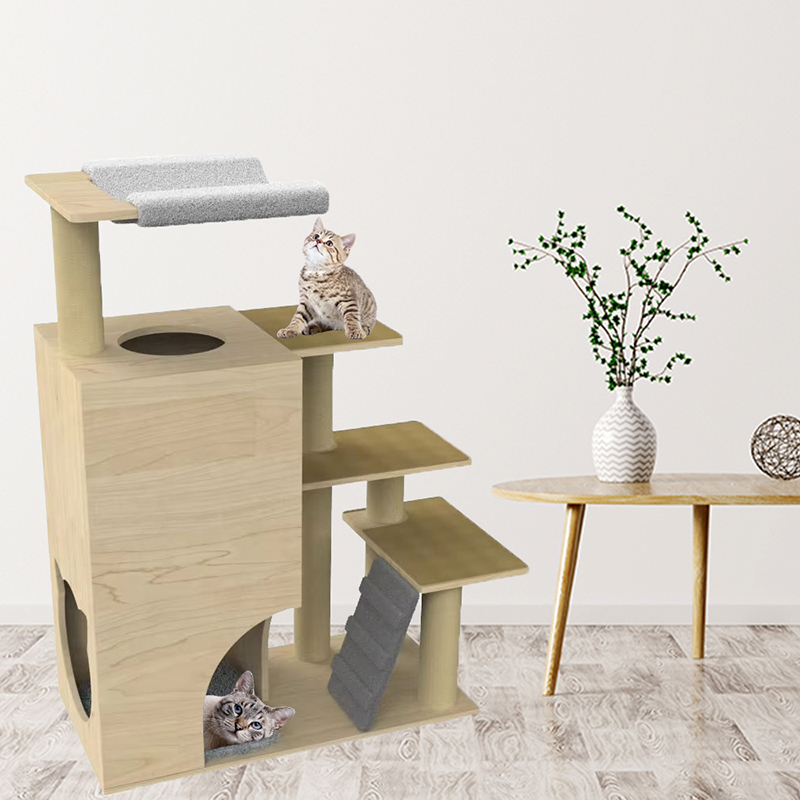 Wood Tower Cat Tree with Sisal Scratching Posts and CondoThis wood cat tree combines a sisal-wrapped scratching post with an elevated sleeping platform, so cats can stretch, mark, climb, and rest in one stable piece.View Product →
A bed with its own scratching board handles a different preference. Some cats want to scratch at floor level before curling up, and a low, flat abrasive surface gives them that without touching the carpet edge. Used together, a vertical post and a horizontal board cover almost every scratching preference an indoor cat develops.
Offer both a vertical post and a horizontal board. Most cats show a clear preference, and offering only one leaves half the problem unsolved.
What Wholesale Buyers Should Check Before Ordering
For importers, distributors and chain retailers, scratching behaviour is a purchasing specification, not a trivia question. A tower that arrives beautiful and wobbles will be returned, reviewed badly and shipped back at your cost. The checks below are the ones that show up again and again in claims and field feedback.
| Specification | Why it matters | Practical range |
|---|---|---|
| Sisal rope diameter | Thin rope frays and unwinds quickly, damaging the brand as much as the post | 4 mm to 6 mm, wound tightly with minimal gaps |
| Post core | Hollow cores collapse under repeated clawing and stop absorbing force | Solid wood or a dense engineered core |
| Base board thickness | Thin boards flex, and flex is read as instability by the cat | 15 mm to 18 mm |
| Base footprint | Footprint decides tip-over risk in homes with children and large cats | Wide enough that the tower barely moves under a firm push |
| Hardware and fixings | Loose bolts are one of the most common reasons for returns | Steel hardware plus an anti-tip strap where height allows |
| Surface finish | Humidity in sea freight can raise the grain on unfinished panels | Sealed edges and a moisture-resistant coating |
| Packaging | Corner damage is visible to the end customer before assembly begins | Corner protectors and a moisture barrier inside the carton |
Wooden furniture-style units deserve a separate look, because they solve two problems for the end customer. A unit that works as a side table or television cabinet and also houses a hidden washroom keeps the litter tray out of sight, which is often the single reason a customer chooses furniture-style cat cages over open wire models. For a wholesaler, that means one container can carry a cat tree, a scratching bed and a cabinet, and the range still reads as a coordinated collection rather than a random assortment.
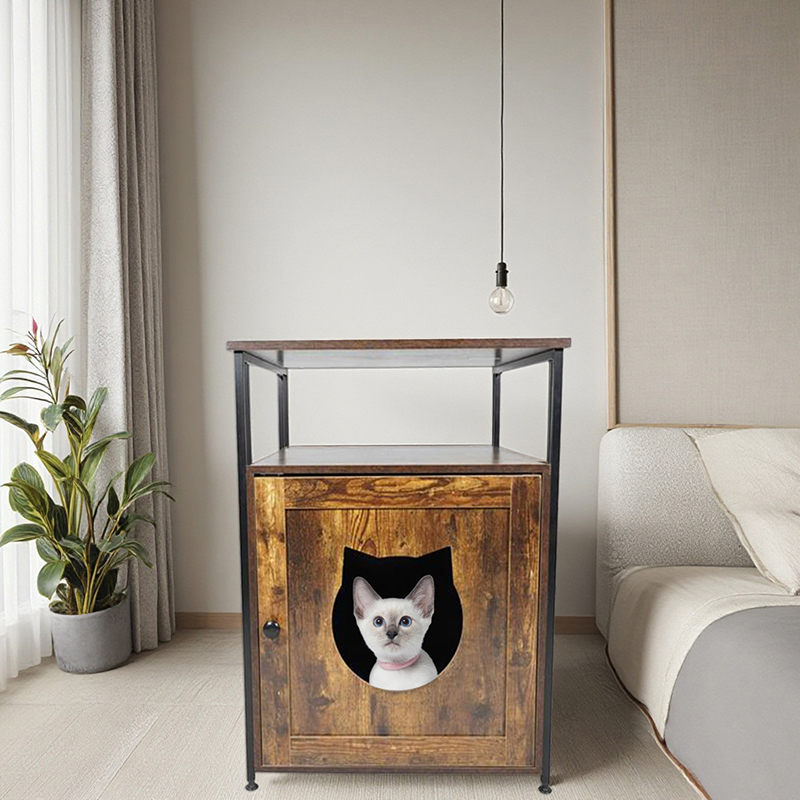 Furniture-Style Cat Litter Cabinet with Indoor Side Table TopThis furniture-style litter cabinet hides the tray behind a ventilated surround while its flat top serves as a side table, making it a practical addition to a coordinated wooden cat furniture range.View Product →
Two further points matter in negotiation. Country standards on wood panels and finishes are not optional, and sizing needs to be flexible enough to fit local living rooms, which is why we build to order rather than pushing a single fixed size across every market. Sampling before a bulk order costs a little time, and it is far cheaper than a rejected container.
Request a physical sample and push it hard by hand. If it moves, the end customer will send it back.
Five Mistakes That Keep the Sofa in Danger
- Buying a post that is too short or too light. A cat cannot stretch fully on a stubby post, and a light base shifts on the first attempt.
- Hiding the post in a spare room. Cats scratch where they already spend time, and a post in an unused corner collects dust instead of claw marks.
- Wrapping the post in carpet. It feels soft, but it shreds quickly and teaches nothing about resistance.
- Removing the protection too early. If the old surface is uncovered before the new one shows wear, the habit simply resets.
- Judging success in days instead of weeks. Habit change in cats usually takes three to eight weeks of consistent placement and reward.
Consistency over weeks beats intensity over days. Scratching habits are learned slowly and unlearned the same way.
Frequently Asked Questions
Do cats scratch furniture on purpose?
Yes, but not with the intention of damaging it. Scratching is purposeful behaviour with a maintenance and communication function. The sofa is simply the most rewarding surface available, so it becomes the regular target.
Will a scratching post stop the behaviour completely?
It stops most furniture damage rather than the behaviour itself. Cats continue scratching, but the marks land on a post or board instead. Most owners see a clear drop in sofa damage within four to eight weeks of consistent placement.
Why does my cat ignore an expensive cat tree?
Usually because of placement or movement. A tower that sits far from the cat's resting area, or that shifts when the cat pushes against it, gets rejected. Move it beside the damaged spot and check that the base is heavy and wide enough.
Is sisal rope better than carpet for scratching posts?
For most cats, yes. Sisal gives firmer resistance, sheds claw sheaths more effectively and holds its shape far longer than soft carpet fibres. Carpet posts tend to look worn out within a few months of daily use.
Do cats scratch more when they are stressed?
Often, yes. A new pet, a move, building work or a change in routine can push scratching frequency up, especially near doors and windows. If the increase comes with spraying or hiding, a veterinary visit is sensible.
Can scratching be redirected without punishment?
Redirecting works, punishing does not. Cats do not connect delayed punishment with an earlier action, and it usually raises stress and scratching. Reward the right surface with play and keep the wrong one protected until the new habit settles.
What should a pet furniture supplier offer for this problem?
A supplier should offer both vertical posts and horizontal boards, tightly wound sisal over solid cores, wide stable bases and flexible sizing for different markets. Test reports and physical samples matter more than catalogue photos.
Do cats scratch furniture more as they get older?
Not usually for behavioural reasons. Older cats may scratch less often, but senior cats sometimes scratch near resting spots because of stiffness. A low, stable board close to the bed usually suits them better than a tall tower.
Every answer comes back to the same point: the cat will scratch, so the useful question is always where the claws land.
Related Reading and Product Categories
If you want to go deeper before choosing a surface, these two pages cover the material reasoning and the wider range.
- Wooden cat tree towers and climbing frames for stable vertical posts, sisal wrapping and multi-level resting platforms.
- Why wood and sisal poles work better as scratching surfaces, with notes on materials and long-term wear.
Furniture damage is one of the few cat behaviour problems where the fix is largely physical rather than psychological. A stable post beside the damaged spot, a sisal surface that actually resists claws, and a horizontal board for cats that prefer the floor will settle most households within a couple of months. From a manufacturing point of view, that is the whole brief: build scratching surfaces that stay still, wear honestly and look good enough to keep in the living room, so the sofa is never the best option available. For owners, the plan is simple, and for importers, wholesalers and retail buyers, it is a specification list worth checking before the next container is loaded.
Related Products
Your pet deserves good, Contact now.
Whether you want to become our partner or need our professional guidance or support in product selections and problem solutions, our experts are always ready to help within 12 hours globally.
 CONTACT US

QUICK LINKS
PRODUCTS
-
Address
- Room 501,Unit 1 ,Buliding 6,Wuyi Guoji Xincheng,No.379,Zhuxi Avenue,Jianyang District,Nanping City, Fujian Province.
- No. 139-6 , Tongyu Middle Road, Nantong, Jiangsu, China
-
Mobile
- +86-13616986006
-
E-mail :

Copyright © 2025 Pet Home (Haian) Co., Ltd All Rights Reserved. Custom Pet Cages Manufacturers OEM/ODM Pet Household Products Factory

