
 EN
 English
 中文简体
Home / News / Industry News / Do Dogs Like Their Crates? Den Instinct, Sizing and Crate Comfort Explained
News


Do Dogs Like Their Crates? Den Instinct, Sizing and Crate Comfort Explained
 2026.10.19
 Industry News
Content
- 1 Do Dogs Like Their Crates? The Short Answer Is Conditional
- 2 What a Dog Actually Wants From an Enclosed Space
- 3 Reading Your Dog: Signs It Likes the Crate and Signs It Does Not
- 4 Sizing Is the Most Common Reason a Dog Dislikes Its Crate
- 5 Placement and Furniture-Style Crates: Where the Crate Sits Changes How It Is Used
- 6 Puppies, Adult Dogs, and Seniors Experience Crates Differently
- 7 Crate or Playpen? Giving a Dog More Room Without Giving Up Control
- 8 When a Dog Genuinely Dislikes the Crate: A Practical Fix List
- 9 What Trade Buyers Should Check Before Ordering Dog Crates
- 10 Frequently Asked Questions
- 10.1 Do dogs like their crates?
- 10.2 Do dogs like crates with the door closed?
- 10.3 Is it cruel to leave a dog in a crate overnight?
- 10.4 Do dogs prefer a bigger crate?
- 10.5 Do dogs like covered crates?
- 10.6 Why does my dog only go into the crate when I have a treat?
- 10.7 Do dogs care whether a crate looks like furniture?
- 11 Explore Our Crate Range
Picture two dogs in the same hallway at nine in the evening. One walks into its crate without being asked, turns around twice, paws at the bedding, and is asleep before the lights go off. The other plants its feet a metre from the door, tail low, and has to be lifted in. Same species, same crate design, completely different response, and that difference has almost nothing to do with whether dogs like crates in some general sense.
Here is the short answer up front: most dogs do not love a crate the way a person loves a favourite armchair. What they value is a small, enclosed, predictable space that smells of them, sits where the family actually spends time, and never becomes the place where something unpleasant happens. When those conditions are met, dogs use crates voluntarily. They retreat to them when the doorbell rings, when children visit, when a storm rolls through. When the conditions are wrong, the crate becomes a cage in the dog's mind, and no amount of cheese will talk it out of that conclusion.
This article looks at the question from the dog's side of the wire: what an enclosed space offers them, how to read whether they are settling or merely tolerating, how sizing and placement change the answer, and what buyers sourcing crates for retail or distribution should keep in mind when they talk to a manufacturer.
The question is rarely whether a dog likes crates in general, but whether it likes this crate, in this spot, introduced in this way.
Do Dogs Like Their Crates? The Short Answer Is Conditional
Owners ask this from two directions. Some are convinced their dog hates the crate and feel guilty every time the latch clicks. Others have a dog that walks in by itself at ten o'clock every night and wonder whether that is normal or whether the dog is simply resigned. Both groups are looking at the same behaviour from opposite ends, and both come back to one fact: a crate is a small room, and small rooms take on whatever meaning the dog learns to attach to them.
A dog likes a crate when the crate behaves like a den and the dog has some control over when to use it. Denning is genuine canid behaviour. Mothers raise litters in sheltered cavities, and adult dogs will choose a sleeping spot with a back wall, one opening, and a clear view of the approach. That is precisely the shape of a crate with three solid sides or a covered top and the door left open. It is also why so many dogs sleep in a crate with the door wide open and ignore the expensive orthopaedic bed beside it.
The part owners miss is control. A den in the wild is chosen, entered and left at will. A crate that is chosen gets the same emotional weight. A crate that a dog is lifted into, pushed into, or left in while panicking gets a different label entirely. Same product, different meaning, and the difference usually sits in the first two weeks.
What liking actually looks like in daily life:
- The dog goes in when it is tired, with no treat in sight.
- It lies flat on one side rather than curled tight against the door.
- It comes out stretching and yawning instead of bolting.
- It returns to the crate after a walk, a meal, or a loud noise.
- It settles within a few minutes rather than pacing for twenty.
None of that requires the dog to be shut in. In fact, a dog that uses an open crate voluntarily is showing a stronger preference than a dog that is silent behind a closed door, because silence can mean comfort or can mean shutdown.
There is practical value beyond sentiment. A dog that is genuinely comfortable in a crate travels better, recovers from surgery more easily, settles in hotel rooms and veterinary clinics, and copes with house moves and renovations. That is why crate training survives even in households where the crate is never used as punishment and never used for long confinement.
A crate stops being a cage the moment the dog chooses to walk into it, and the fastest route to that point is making the crate the most comfortable resting spot in the house.
What a Dog Actually Wants From an Enclosed Space
Watch a dog choose where to sleep and you will see it checking four things: whether it fits, whether it can see out, whether the air moves, and whether the structure holds still when it leans against it. Get those four right and most dogs will use a crate with no persuasion at all. Get them wrong and the crate becomes a battle every evening.
Room to stand, turn, and lie flat
The working rule is simple. Interior height should let the dog stand with its head up and ears clear of the roof, usually two to three inches above the top of the head. Interior length should run from the tip of the nose to the base of the tail plus two to four inches. Interior width should allow a full circle without the shoulders scraping both sides. The test takes ten seconds: put the dog in, and check whether it can stand without crouching, turn around, and lie fully on one side with legs extended.
Two mistakes are common. The first is buying for the adult size of a puppy, which leaves a small dog rattling around in a space that feels exposed and encourages soiling in one corner; a divider panel solves that. The second is ignoring height. A tall, narrow breed such as a greyhound or a rough collie needs vertical clearance far more than extra floor area, while a bulldog needs a wider footprint and a lower entry.
Sight lines, airflow, and a door that is not a threat
A den has a view. Wire construction gives an almost panoramic view and good airflow, which suits dogs that want to monitor the room. Wooden furniture-style cages trade some visibility for shelter and quiet, which suits dogs that startle at movement. Covered crates sit in between and are useful for noise-sensitive animals, provided the cover goes over three sides and never over the door end.
Airflow is not a detail. A wooden crate with tight panels in a warm room becomes uncomfortable quickly, so ventilation gaps and a sensible position away from radiators, sunny windows and heating vents matter more than the finish. Door design matters too. Some dogs dislike a door that swings towards them, and an open-top cage that lets an owner reach in from above can make the difference between a calm lift and a wrestling match when a sick or elderly dog needs moving.
Structure that survives real dogs
An anxious dog will test every weld in the frame. Thicker tube frames resist bending better than light mesh, powder coating resists rust and repeated chewing, and latches need two points of contact rather than a single hook that a clever dog can nose open. Floor trays should slide out for cleaning without rattling when the dog steps in, and folding frames need locking pins that do not work loose after a few dozen cycles.
For dogs that chew at bars, an anti-chew build with a heavier top rail and fewer exposed weld joints matters more than the colour of the finish. In multi-dog households, stackable frames save floor space, but only if the stacking hardware is solid and the dogs get along.
Every crate decision is a trade-off between visibility and shelter, room to move and snugness, strength and weight, and the right balance changes with the dog rather than with the trend.
Reading Your Dog: Signs It Likes the Crate and Signs It Does Not
The clearest signal is not what the dog does once it is inside. It is what it does when the door is open and it has a choice. The table below is a practical translation guide for the behaviours owners most often misread.
| Behaviour | What it usually means | What to check first |
|---|---|---|
| Walks in on its own when tired, settles within minutes | The crate is being used as a resting place | Keep the location, bedding and routine stable |
| Sleeps on its side with legs extended, breathing slow | Deep relaxation rather than tolerance | Leave the dog alone and do not disturb the sleep |
| Waits beside the crate at bedtime | The crate is part of a predictable routine | Keep the schedule, especially before travel |
| Pants, paces, digs at the tray, drools | Stress, often from size, heat or time alone | Measure the interior, check room temperature, shorten sessions |
| Leans away, freezes, refuses food near the door | Fear or a negative association with the crate | Stop closing the door and rebuild with meals served inside |
| Chews bars, bites the door, tries to climb out | Frustration, confinement anxiety or too little exercise | Longer exercise, shorter confinement, consider a playpen instead |
| Only enters when a treat is visible | Tolerance rather than preference | Build value with meals and long-lasting chews, not just luring |
Owners often report the quieter signals without realising what they mean. A relaxed jaw and soft mouth, ears sitting in their natural position, one paw resting outside the door, a sigh as the dog lies down, slow blinking, and coming out voluntarily when called are all signs of an animal that feels safe. A dog that holds its breath when the latch clicks, or that drops its head and freezes when a hand reaches for the door, is telling you something different.
One behaviour on its own proves little. A dog may pace for a minute before settling simply because it has energy to burn, and a dog may sleep deeply in a crate it would never enter by choice because it is exhausted. Look for the pattern across a week, and pay particular attention to whether the dog returns to the crate after being let out. Returning is the strongest single indicator that the space has become a preference.
A dog's posture and its willingness to go back in tell you far more about crate comfort than how quiet it is behind a closed door.
Sizing Is the Most Common Reason a Dog Dislikes Its Crate
Most crate complaints that sound behavioural turn out to be dimensional. A dog that cannot stand up straight, or that has to fold itself in half to turn around, will resist the crate no matter how many treats appear at the door. The reference below connects common crate lengths to the body length they generally suit, which is a quicker starting point than working through breed lists.
Crate length against the body length it typically fits
24 in Body length up to 14 in, toy and small terrier breeds
30 in Body length up to 18 in, pug, French bulldog, Shetland
36 in Body length up to 22 in, beagle, cocker spaniel, border collie
42 in Body length up to 26 in, Labrador, German shepherd
48 in Body length up to 30 in, large mastiff breeds and giant dogs
The chart is a starting point rather than a rule, because body shape shifts the answer. A deep-chested breed needs more height, a long-backed breed needs more length, and a dog that likes to stretch out flat on its side needs a slightly longer interior than one that curls. Measure your dog standing, not curled on the sofa, and measure interior dimensions rather than the number printed on the carton, since many factories quote exterior length.
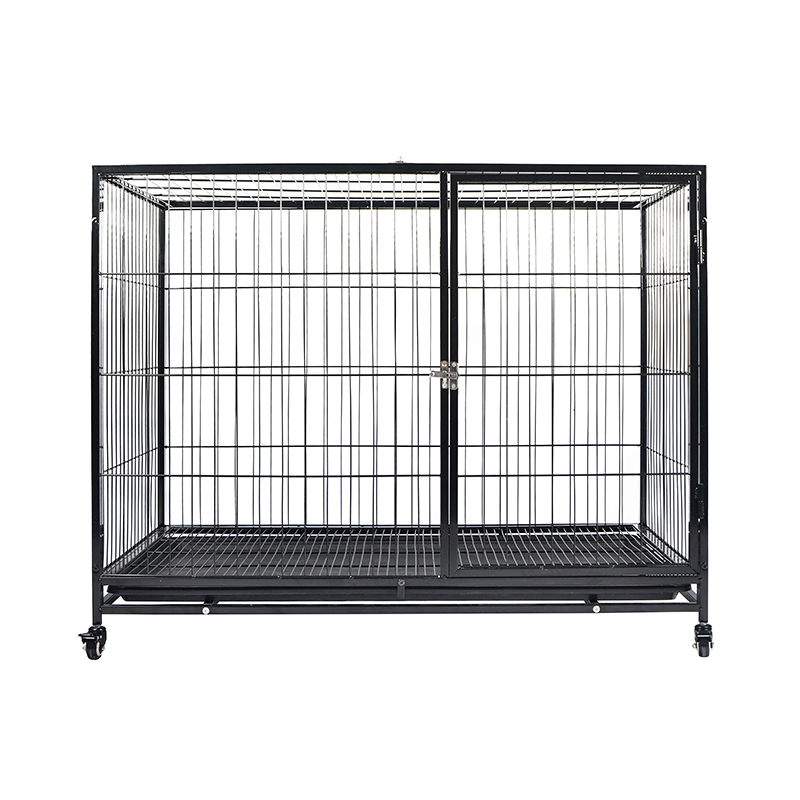
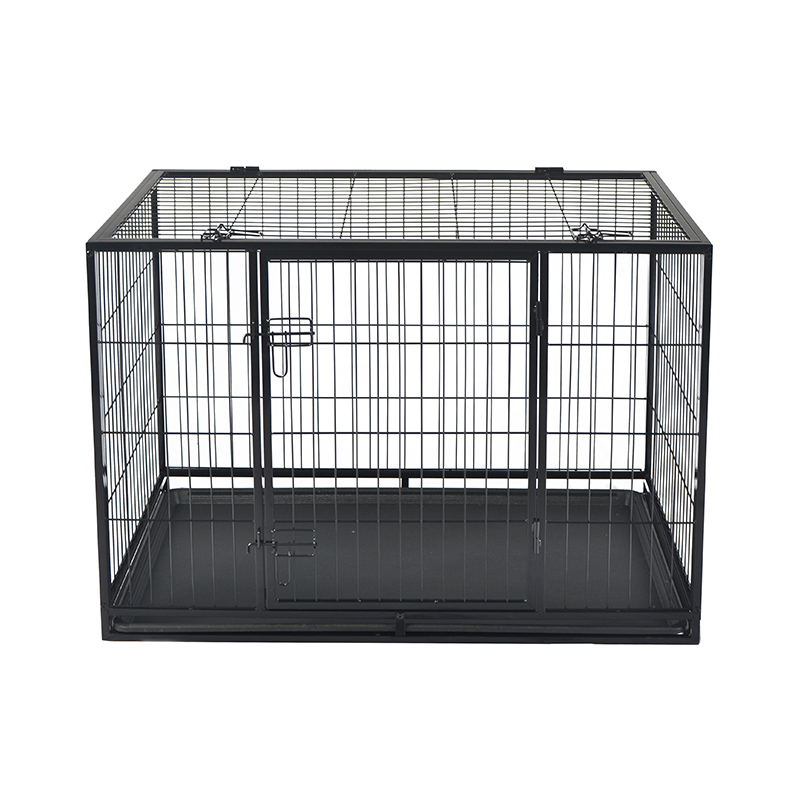
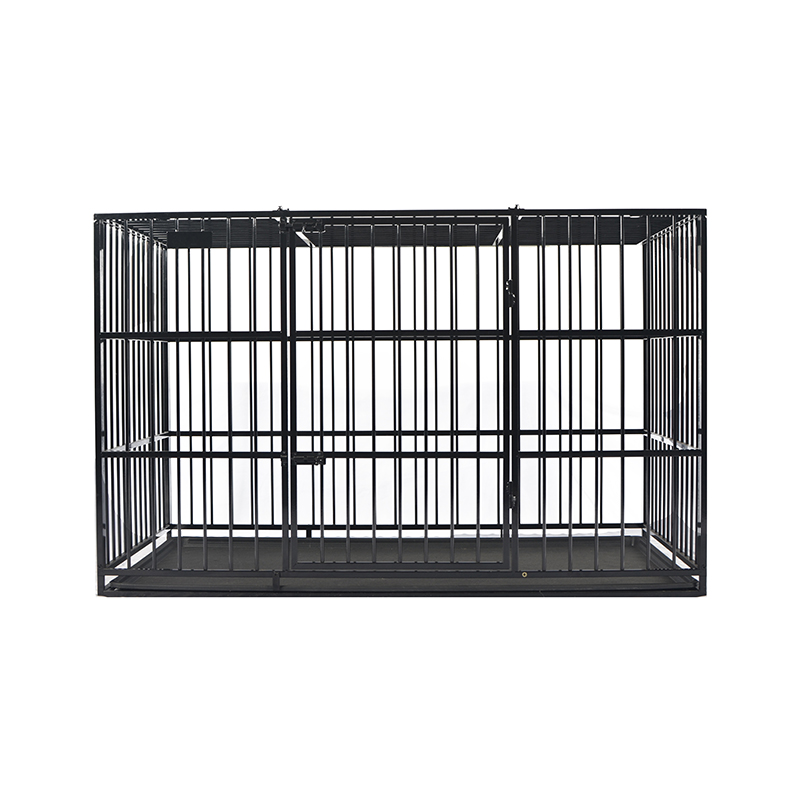
This is exactly where a specification conversation with the factory pays off. A well-built metal dog cage quotes interior length, interior height and bar spacing separately, and a good supplier will tell you which sizes map to which breeds rather than leaving the retailer to guess. In our own range, the larger open-top tube builds run from 36 inches through 42 inches to XXL, with interior dimensions listed so a buyer can compare directly against a measuring tape at home.
 Heavy-Duty Open-Top Metal Dog CageOpen-top tube build with front and top doors, folding frame, braked wheels and pull-out ABS tray; larger sizes run from 36 inches to XXL.View Product →
The heavy-duty open-top metal dog cage is a useful example of how structure follows the sizing problem. The open top gives a tall dog clearance without forcing a longer footprint into a small room, the heavier tube frame resists bending when a dog throws its weight against the side, and the anti-chew geometry removes the easy grab points that anxious dogs work on. The same platform appears in foldable, stackable and XXL variants, which is what kennels, breeders and retail buyers tend to need when they are covering several size bands from one supplier.
If a dog fits properly, most crate resistance disappears; if it does not fit, no training plan will fix a crate that is four inches too short.
Placement and Furniture-Style Crates: Where the Crate Sits Changes How It Is Used
The same crate behaves completely differently in two rooms. Dogs are social sleepers. They want to be near the group, which is why a crate in the corner of a busy living room gets used all evening, while an identical crate in a utility room gets used only when someone shuts the dog in. Placement is not decoration; it is a large part of whether the dog chooses the crate at all.
A few practical rules cover most homes. Put the crate with a wall or a solid side behind it and the opening facing the room, so the dog can watch the approach. Keep it out of direct sun and away from radiators, heating vents and draughty doorways. Do not block a walkway, because a crate that people trip over gets moved, and a crate that moves every week never becomes familiar. In a two-storey house, either buy two crates or choose a build with wheels, since a dog will not follow a routine up and down stairs.
When the crate has to look like furniture
Plenty of owners give up on crates for a simple reason: a wire cage in the middle of a living room is hard to live with. Furniture-style dog cages solve that problem by making the crate part of the room. An end table crate sits beside the sofa and holds a lamp; a corner table crate fills dead space; wooden panels with ventilation slots keep the interior calm while the outside reads as furniture.
The design details decide whether the piece works in daily use. Check which side the door opens on, because a door facing the wall is useless. Check that ventilation is real rather than decorative, that the tray slides out without moving the whole cabinet, that the cushion is thick enough to protect joints, and that the frame is rated for the dog's weight when it launches itself in. Assembly time matters too, since a flat-pack crate that takes two hours to build rarely gets moved once it is up.
 Indoor Dog Crate End Table with Wooden TopWood-topped metal crate doubles as a side table, with double-sided mesh door, swivel lock and wipe-clean surface for indoor daily use.View Product →
The indoor dog crate end table is built around that set of compromises. It carries a wooden top that works as a side table, a metal interior frame for structural strength, ventilation on the closed sides, and a size run that covers small companion breeds up to medium dogs. Related builds in the same family add wheels and cushions, or shift the shape to a corner footprint, which gives a retailer a coordinated story rather than a single SKU.
A crate the owner is happy to keep in the living room gets used every day, while a crate hidden in a back room gets used only when someone remembers it.
Puppies, Adult Dogs, and Seniors Experience Crates Differently
Puppies
A puppy's relationship with a crate is built in about two weeks, and it is built on meals, naps and toilet timing rather than on authority. Feed every meal inside with the door open, put the puppy in when it is already sleepy rather than when it is wound up, and take it out for a toilet break before it asks. Expect night waking for the first few weeks; that is bladder capacity, not stubbornness.
Buy for the adult size and use a divider, or accept that you will buy twice. The commonly quoted guideline that a puppy can hold its bladder for roughly one hour per month of age, up to a maximum of about four to five hours, is a reasonable planning tool for daytime confinement, though individual puppies vary. The crate should never be the place a puppy is put for a telling-off, because that association is very hard to undo.
Adult dogs and rescues
With an adult dog, especially a rescue, assume nothing. A dog that panics in a crate may have spent long stretches shut in one, and the behaviour is not defiance. Start with the door removed entirely, feed inside, and do not close the door for a week or more. Watch for barrier frustration, where the dog is fine with the crate until the door shuts and then redirects onto the bars. That pattern usually calls for a different tool rather than more training.
Senior dogs and dogs recovering from surgery
Older dogs need padding, warmth, a low entry and a door that opens wide. Arthritis makes a hard tray painful, so a thick washable bed is not a luxury. After surgery or during crate rest ordered by a vet, the crate has to be genuinely comfortable for weeks at a stretch, which means correct interior height, a tray that slides out for cleaning, and an opening wide enough that the dog walks in rather than being manoeuvred. An open-top design is a real advantage here, because a dog can be lifted from above without being dragged through a door.
In multi-dog homes, give each dog its own crate and never stack dogs that guard space. Stackable frames are designed for kennels and breeding setups where the animals are separated and the structure is fixed, not for two pets that argue over a shared wall.
The crate that suits a puppy is rarely the crate that suits the same dog at eight years old, so planning for one replacement is cheaper than forcing a bad fit.
Crate or Playpen? Giving a Dog More Room Without Giving Up Control
Some dogs dislike the closed door but are perfectly relaxed in a small fenced area. That is not a contradiction. A crate is a den, which means tight and sheltered; a playpen is a small yard, which means room to move, a water bowl, a bed and a toilet area in one place. The two solve different problems and often work best as a pair.
A playpen gives two or three times the floor area of a crate, which makes it better for daytime confinement, house-training setups, whelping, post-surgery rest where the dog needs to move gently, and renovations where a dog has to be kept off the floors. The trade-offs are real: determined jumpers and climbers get out, a pen takes up more room, and it is not practical for travel. A crate remains better for sleeping, car journeys, veterinary visits and short-term safety.
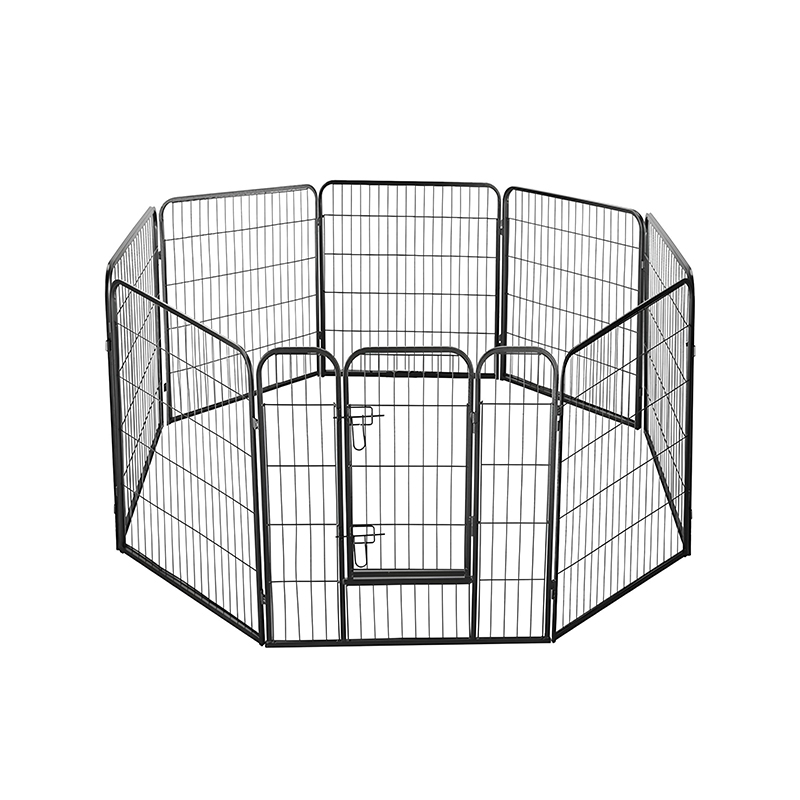
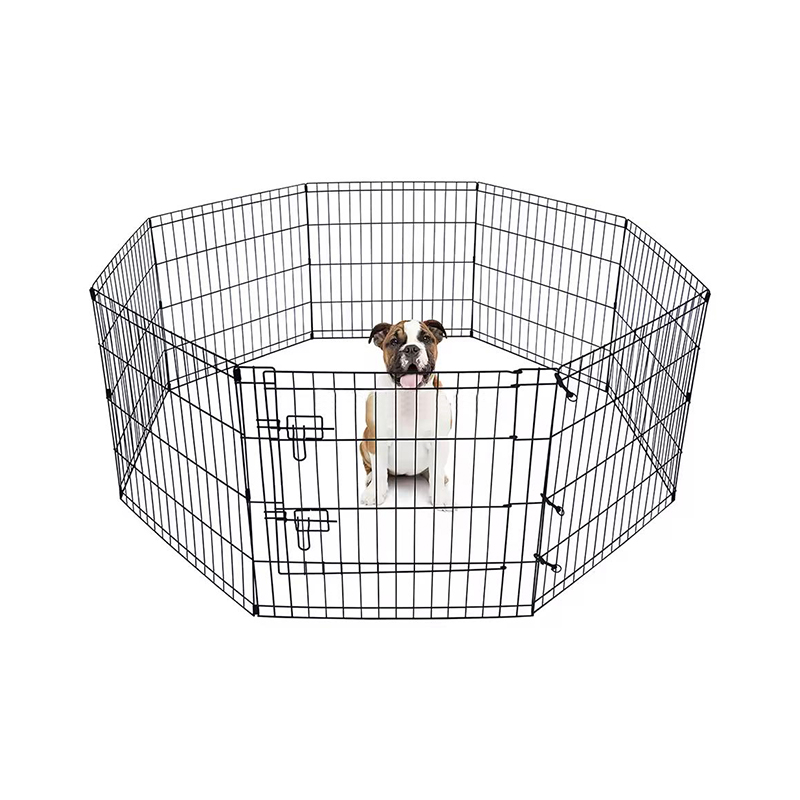
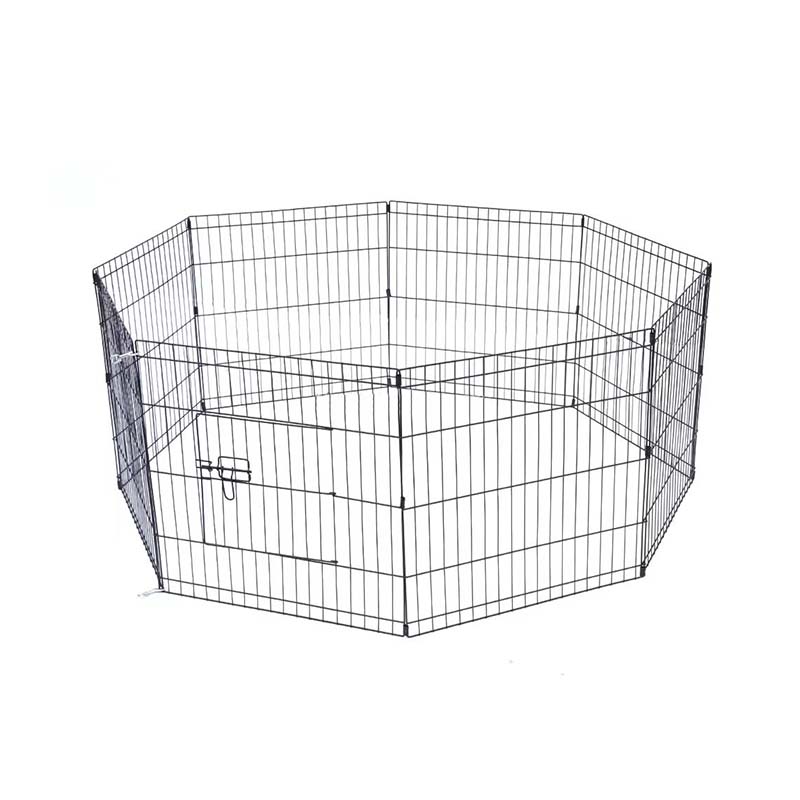
 8-Panel Foldable Wire Metal Dog PlaypenFold-flat eight-panel wire playpen with sliding locking door, removable poles and multiple sizes; useful as daytime indoor or outdoor exercise space.View Product →
The eight-panel foldable wire playpen covers the middle ground well. Eight panels fold flat for storage and can be arranged as a rectangle, a square or an L-shape against a wall. A top cover stops climbing escapes, a bottom pad protects floors and gives the dog a defined surface, and the wire construction keeps airflow and visibility high, which matters for a dog that gets anxious when it cannot see the room. Paired with a crate for sleeping, it gives owners a daytime option without turning the crate into a full-day holding cell.
For outdoor use, the same logic applies with weather in mind. Outdoor exercise pens and covered runs let a dog spend time outside without being tethered, while the crate stays indoors as the sleeping place. Mixing the two is often the fastest fix for a household that has been trying to make one product do every job.
Crates are for sleeping and travel, pens are for daytime, and most dogs that dislike one are completely comfortable in the other.
When a Dog Genuinely Dislikes the Crate: A Practical Fix List
Before assuming the dog is difficult, work through the basics in order. Most crate problems are solved in the first three steps.
- Feed every meal inside the crate with the door open, and put the bowl progressively further in over a week.
- Remove the door entirely for a few days so the dog can walk in and out without a barrier.
- Re-measure the interior against the dog's standing height and nose-to-tail length, then check room temperature and airflow.
- Move the crate into the room where the family sits, with a wall behind it rather than a draughty doorway.
- Cover three sides with a light blanket, never the door end, and watch whether the dog settles or gets warmer and more restless.
- Exercise the dog properly before any confinement period, because a bored dog in a crate is a chewing dog.
- Build duration slowly, starting with seconds and adding time only when the dog is calm at the current step.
- Remove collars and tags before closing the door, since a collar tag can catch between bars.
- Never use the crate as punishment, and never drag a resisting dog in by the collar.
There are cases where the answer is not more training. If a dog injures itself against the bars, breaks teeth, soaks itself in drool within minutes, or cannot be left without destructive panic, that is confinement anxiety and it needs a veterinarian or a qualified behaviour professional. For some of those dogs the right outcome is no crate at all and a playpen, a dog-proofed room, or a combination of both.
One safety point deserves repeating. Crates are not long-term storage. Adult dogs should not spend a full working day shut in one, and the commonly cited limits of four to six hours for a settled adult dog, with a proper break in between, exist because physical comfort and bladder capacity have limits that training cannot override.
If a dog injures itself trying to escape, the crate is the wrong tool for that animal, and no training plan should be attempted without professional guidance.
What Trade Buyers Should Check Before Ordering Dog Crates
For a retailer, wholesaler or distribution business, crate selection is a specification exercise rather than a style decision. The dogs owned by the end customer will decide whether a crate line sells again next season, and that judgement is made on fit, strength and ease of cleaning rather than on catalogue photography.
- Interior dimensions quoted separately from exterior length, with a stated tolerance.
- Wire gauge or tube wall thickness, plus the load the top rail can take when a dog stands on it.
- Powder coating specification, including film thickness and salt spray performance for humid markets.
- Latch and hinge testing, with a stated cycle count and a note on two-point locking.
- Bar spacing that prevents a muzzle or paw passing through, especially on the smallest sizes.
- Tray fit and material, since a rattling or warping tray is the most common after-sales complaint.
- Carton drop test results and a container loading plan that reflects real carton dimensions.
- Spare parts availability for latches, trays and wheels.
- Sample lead time and a clear customisation path for sizes, finishes and private labelling.
Our own position in that supply chain is as a manufacturer rather than a trading office. The company was established in 2009 as a combined production and export operation, runs two metal dog cage production lines and one furniture-style pet cage line, and ships more than fifty containers a month to markets including the United States, Australia, Germany, the Netherlands, Japan and Mexico. An in-house design team handles OEM and ODM work, from concept drawings through physical sample testing to mass production, and the factory supports size adjustment for markets with different breed profiles.
Range planning benefits from dealing with one supplier across categories. A wholesaler building a crate category can combine metal dog cages, furniture-style dog cages, dog playpens and elevated dog beds, then extend into cat trees, wooden cat houses and small animal hutches for a fuller aisle. That reduces the number of containers, simplifies compliance paperwork, and makes it easier to keep a coherent finish and colour story across the range.
A crate programme stands or falls on specification discipline, so the supplier conversation should start with interior dimensions and tolerances rather than with a price per unit.
Frequently Asked Questions
Do dogs like their crates?
Many dogs do, in the specific sense that they choose the crate as a resting place and return to it without being asked. That preference is not automatic. It depends on the crate fitting correctly, sitting in a room where the family spends time, and never being associated with punishment or long, anxious confinement.
Do dogs like crates with the door closed?
Some do and some do not, and the difference is usually duration. A few minutes behind a closed door for sleep, travel or safety is normal for a crate-trained dog. Long stretches with the door shut, especially for a dog that has not been taught to settle first, is where most crate problems begin.
Is it cruel to leave a dog in a crate overnight?
Overnight is generally the easiest period, because the dog would be sleeping anyway. What matters is that the crate is correctly sized, the bedding is comfortable, the room is not too warm, and the dog has had exercise and a toilet break before bed. A dog that pants, paces or tries to escape at night is not sleeping, and that needs attention rather than patience.
Do dogs prefer a bigger crate?
Not necessarily. Dogs generally prefer a crate that fits: enough height to stand, enough length to lie flat, enough width to turn. A crate that is far too large feels exposed and can encourage a puppy to soil one end and sleep in the other. Fit beats volume every time.
Do dogs like covered crates?
Many noise-sensitive dogs settle better with a cover over three sides, because it turns a wire box into a cave. Keep the door end open for air and sight, and check the interior temperature regularly, since a covered crate in a warm room becomes uncomfortable quickly.
Why does my dog only go into the crate when I have a treat?
Because the crate has become a transaction rather than a place. The fix is to stop luring and start building value: feed meals inside, hide long-lasting chews in the bedding, leave the door open all day, and let the dog discover that good things appear in the crate whether or not a human is standing there.
Do dogs care whether a crate looks like furniture?
Dogs care about fit, warmth, airflow and location, not about style. The reason furniture-style crates help is indirect: owners keep them in the living room instead of hiding them, and a crate in the living room is a crate the dog actually uses.
In almost every case, the dog's answer depends less on the crate itself and more on the fit, the placement, and the first two weeks of experience.
Explore Our Crate Range
If you are sourcing crates for retail, distribution or a kennel operation, the two pages below are a practical starting point: one covers the metal dog cage range in detail, the other explains why the open-top heavy tube design improves day-to-day life for dogs and owners alike.
Metal dog cages: open-top, foldable and stackable builds
Why the open-top heavy tube design improves daily life and safety
Choosing the right crate is a conversation about dimensions, structure and where the crate will live, not a catalogue order.
Related Products
Your pet deserves good, Contact now.
Whether you want to become our partner or need our professional guidance or support in product selections and problem solutions, our experts are always ready to help within 12 hours globally.
 CONTACT US

QUICK LINKS
PRODUCTS
-
Address
- Room 501,Unit 1 ,Buliding 6,Wuyi Guoji Xincheng,No.379,Zhuxi Avenue,Jianyang District,Nanping City, Fujian Province.
- No. 139-6 , Tongyu Middle Road, Nantong, Jiangsu, China
-
Mobile
- +86-13616986006
-
E-mail :

Copyright © 2025 Pet Home (Haian) Co., Ltd All Rights Reserved. Custom Pet Cages Manufacturers OEM/ODM Pet Household Products Factory

