
 EN
 English
 中文简体
Home / News / Industry News / Dog Crate Dimensions: Interior Measurements, Sizing Rules and Wholesale Specs
News


Dog Crate Dimensions: Interior Measurements, Sizing Rules and Wholesale Specs
 2026.11.03
 Industry News
Content
- 1 How Dog Crate Dimensions Are Measured in Real Production
- 2 Matching a Crate to Your Dog With Three Measurements and Two Allowances
- 3 Standard Size Classes and Where the Dog Crate Dimensions Break Down
- 4 Bar Spacing and Door Openings Decide Whether the Numbers Work
- 5 Furniture-Style Crates: When the Footprint Becomes Part of the Dimension
- 6 Playpens, Big Dog Cages and Outdoor Runs: Area Instead of Length
- 7 Interior Floor Area by Nominal Size: A Visual Comparison
- 8 Container, Carton and Wholesale Planning Around Crate Dimensions
- 9 A Pre-Order Checklist for Owners and Trade Buyers
- 10 Frequently Asked Questions About Dog Crate Dimensions
- 10.1 What size crate fits a 60 lb dog?
- 10.2 Should I buy a crate one size larger for a puppy?
- 10.3 How do I measure my dog for a crate correctly?
- 10.4 Do crate dimensions include the tray and the wheels?
- 10.5 What is the real difference between a 42-inch and a 48-inch crate?
- 10.6 How much space does a dog need to turn around inside a crate?
- 10.7 What bar spacing is safe for a small puppy?
- 10.8 Can a manufacturer build a custom interior size?
- 10.9 Do interior dimensions differ between metal and furniture-style crates?
- 11 Where to Go Next
A 36-inch crate sounds like a fixed object. In practice, two crates sold under that label can differ by two and a half inches of usable floor length, and that gap decides whether a dog lies flat through the night or curls up against a door bar with its nose pressed to the mesh.
The label is a nominal class, not a measurement. The frame tube, the tray lip, the hinge plate and the door latch all sit inside the number printed on the box, so the space your dog occupies is always smaller than the space the crate advertises. This is why the same dog can look comfortable in one 36-inch crate and cramped in another, and why a buyer comparing quotes from two factories can end up with two different products under one purchase order line.
The practical rule is short: buy and specify by interior usable dimensions, then check bar spacing, door opening and carton volume. Exterior figures describe how the crate fits your room or your container. Interior figures describe how it fits the dog. The two are related but never identical, and the difference is where most sizing mistakes, returns and freight surprises come from.
Conclusion first: dog crate dimensions should be quoted as interior usable length, width and height, measured after the frame, tray and door hardware are in place.
How Dog Crate Dimensions Are Measured in Real Production
Every crate carries three sets of numbers, and they rarely match: the nominal size on the retail label, the exterior frame dimensions in the spec sheet, and the interior space the animal actually uses. Owners mostly see the first. Wholesale buyers, distributors and retail category managers need all three, because a container loaded with crates built to a loose spec can arrive with three slightly different interior footprints if nobody locked the drawing down.
Exterior length includes the frame tube itself, the hinge side, and any latch hardware that protrudes past the panel. On a typical wire crate built from a 0.4-inch tube, exterior length runs roughly 0.75 to 1.5 inches longer than the usable interior floor. Height is more deceptive. A crate with a 30-inch exterior height often leaves 26 to 27 inches of standing room once the top frame, the bottom tray lip and a small floor clearance are counted, and a 2-inch cushion takes another 2 inches away.
Production tolerance matters here too. Frame length on a welded wire panel is usually held to within a few millimetres, mesh spacing is checked against a gauge rather than by eye, and powder coating adds a thin but measurable layer to every bar. Those millimetres are normal for the category, but they mean a buyer who specifies "interior 34 inches" should also specify the acceptable range. Otherwise the factory delivers 34 inches within its standard allowance and the retail listing no longer matches the carton.
| Nominal size | Typical exterior (L x W x H) | Typical interior floor (L x W) | Usable interior height | Common dog range |
|---|---|---|---|---|
| 18 inch | 18 x 12 x 14 in | 16.5 x 11 in | 12.5 in | Very small breeds under 10 lb |
| 24 inch | 24 x 18 x 19 in | 22.5 x 16.5 in | 17.5 in | Small breeds, 10 to 25 lb |
| 30 inch | 30 x 19 x 21 in | 28 x 17.5 in | 19.5 in | Medium breeds, 26 to 40 lb |
| 36 inch | 36 x 23 x 25 in | 34 x 21.5 in | 23 in | Medium to large, 41 to 70 lb |
| 42 inch | 42 x 28 x 30 in | 40 x 26.5 in | 28 in | Large breeds, 71 to 90 lb |
| 48 inch | 48 x 30 x 32 in | 46 x 28.5 in | 30 in | Extra large, 91 to 110 lb |
Read the table as a starting point, not a guarantee. Two crates that both list 36 inches can land at 34 x 21.5 inches and 33 x 20 inches inside depending on how the door frame is built and whether the tray sits inside the frame or below it. When a listing only gives one number, assume it is the exterior length, and ask for the rest.
A single dimension on a label is almost always the exterior length, so any serious specification has to list interior length, interior width and usable height separately.
Matching a Crate to Your Dog With Three Measurements and Two Allowances
The dog side of the calculation needs three numbers taken at home, not from a breed chart. Breed charts describe averages across a whole population, while your dog is one specific animal with one specific back length.
- Measure from the tip of the nose to the base of the tail with the dog standing squarely on a hard floor. The tail itself does not need crate space, but a dog that sleeps curled will use the diagonal.
- Measure from the floor to the top of the head with the neck in a natural standing position, not sitting. A sitting measurement flatters the crate and produces a tight fit.
- Measure across the widest point of the shoulders or ribcage.
- Add 2 to 4 inches to body length and to standing height, and allow roughly 50 percent extra width so the dog can turn around and lie flat on its side with legs extended.
- Compare the results with interior figures only, and subtract any cushion, bed or water bowl you plan to place inside.
The two allowances are where judgement enters. Length allowance protects the spine and the sleeping posture, and a dog that cannot stretch out will sleep against the door, which is the start of most crate refusal problems. Height allowance protects the ears and the head clearance when the dog stands to turn. A rule of thumb that holds across most breeds: if the dog has to lower its head to stand, the crate is too short, even if the label says the size is right.
For puppies, the usual advice to buy the adult size is correct, but it needs a divider to be useful. A 42-inch interior with a divider that creates a 24-inch sleeping area gives a young dog the right amount of space now and the full area later. Without the divider, a large crate becomes a bedroom plus a bathroom, and house training slows down.
Deep-chested breeds such as sighthounds need height more than length, while long-bodied breeds such as dachshunds need length far more than height. That mismatch is the single most common reason a customer returns a crate that was technically the right nominal size.
Two to four inches of clearance over body length and standing height, plus about 50 percent extra width for turning, covers almost every dog without wasting floor space.
Standard Size Classes and Where the Dog Crate Dimensions Break Down
The 18, 24, 30, 36, 42 and 48 inch ladder is a retail convention, not an engineering standard. It grew up around imperial measurements in North America, and it does not translate cleanly to markets that work in centimetres. A European buyer may ask for a 76 cm, 91 cm or 107 cm crate, which lands close to but not exactly on the 30, 36 and 42 inch classes. When a supplier quotes both systems, the centimetre figure is usually the interior length and the inch figure is usually the exterior, which is a reliable source of confusion in first orders.
The ladder breaks down in four predictable places. Giant breeds exceed the 48-inch class and need 54-inch or custom interiors. Long-bodied breeds run out of length before they run out of height. Narrow-chested but tall breeds fit a 36-inch length and still need 42-inch height. And puppies need a small usable area inside a large frame, which is a divider problem rather than a size problem.
For trade buyers, the useful move is to define your own class table once and keep it across every purchase order. Interior length, interior width, interior height, bar spacing, door opening width and folded thickness are enough to remove most ambiguity. Factories that build both metal and furniture-style lines, and that already adjust dimensions for different national markets, can usually hit a custom interior within a normal tooling range, but the acceptable tolerance still has to be written down.
The inch ladder is a marketing convention, so a private class table with interior figures and tolerances removes far more risk than debating nominal sizes.
Bar Spacing and Door Openings Decide Whether the Numbers Work
A crate can have a perfect interior footprint and still be unsafe. Bar spacing controls whether a puppy can push its head between the wires, and door opening width controls whether a large dog walks in or has to be lifted. Neither number appears on most retail labels.
As a working guide, spacing of roughly 1 to 1.5 inches suits toy and small breeds, 1.5 to 2 inches suits medium dogs, and wider spacing is only appropriate for large dogs that cannot pass a muzzle through. For a growing puppy, the risk window is short but real, and it is one reason a 1.5-inch mesh is often specified for the small and medium classes in export orders.
Door design changes the usable interior more than people expect. A door that swings outward needs clearance in front of the crate, which matters in a furniture-style unit pushed against a wall. A door with a top hinge and a full-width opening lets a nervous dog walk in without ducking. An open-top structure removes the height conflict entirely for dogs that are lifted in and out, and it also gives access for cleaning without dismantling the frame.
Open-top and heavy tube designs are not cosmetic choices. A heavier tube resists bending when a dog pushes against the door, and a top-opening panel changes how the crate is used during vet visits, travel and post-surgery rest. Buyers evaluating these structures should still confirm the folded thickness, because a reinforced frame usually adds 0.2 to 0.5 inches to the packed carton.
 Open Top Anti-Chew Metal Dog Cage with Double DoorsFeatures a top-opening door, reinforced tube frame, and pull-out leak-proof tray for easier cleaning and secure daily containment.View Product →
Bar spacing and door opening width belong in the specification alongside interior size, because they decide safety and daily handling more than length alone.
Furniture-Style Crates: When the Footprint Becomes Part of the Dimension
An indoor furniture-style dog crate adds a second set of dimensions: the outside of the cabinet. A unit designed as an end table has a top surface that overhangs the cage body by an inch or two, so the floor footprint is larger than the crate interior, and the tabletop height is taller than the usable interior height. Owners planning to place a lamp or a cup of coffee on top need the surface height; buyers planning a retail display need the outer footprint.
The interior numbers also shift. A wooden or wood-metal cabinet usually carries a thicker frame than a wire crate, often 0.6 to 0.8 inches per side, so a 36-inch exterior length can leave 33 to 34 inches inside. A removable tray at the bottom sits below the cage floor and does not reduce interior length, but a fixed tray lip can reduce interior width by half an inch on each side.
Cushions and wheels are the two most overlooked variables. A 2-inch cushion reduces standing height by 2 inches, which can turn an adequate 42-inch unit into a tight one for a tall dog. Castors typically add 1.5 to 2.5 inches to overall height and make the unit easy to move for cleaning, but they also raise the tabletop for anyone using it as a side table. Corner-table shapes trade interior floor area for wall fit, so a corner unit with the same exterior footprint usually offers less usable length than a rectangular one.
 Wooden Furniture-Style Dog Crate End Table with Wire MeshCombines a solid wood frame, ventilated wire door, and wipe-clean top shelf for indoor crate use that doubles as furniture.View Product →
For wholesalers and retail buyers, furniture-style crates are a different freight and display problem from wire crates. They are heavier, they are usually shipped knock-down, and the assembled dimensions printed on the retail box have to be paired with a packed dimension for logistics. Getting those two numbers right at the sampling stage prevents a listing that promises a table height the assembled unit cannot reach.
For furniture-style crates, quote four dimensions: interior floor, usable interior height with the cushion in place, outer footprint, and tabletop height with wheels fitted.
Playpens, Big Dog Cages and Outdoor Runs: Area Instead of Length
Once the product stops being a closed box and becomes an enclosure, length stops being the useful number and floor area takes over. A folding metal playpen is described by panel count and panel height, not by a single length, because the shape can be square, rectangular or fully open against a wall.
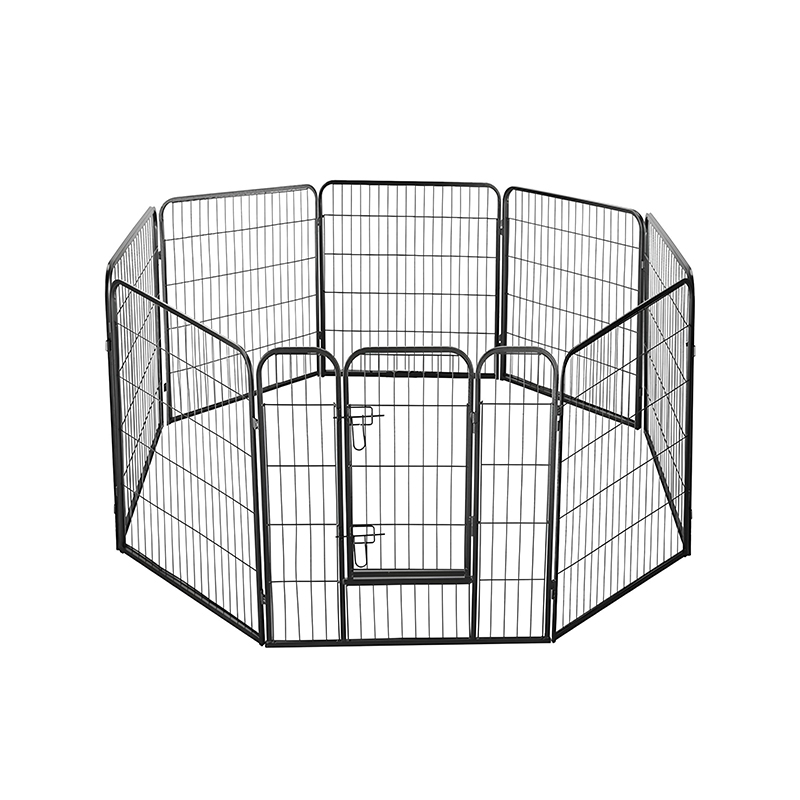
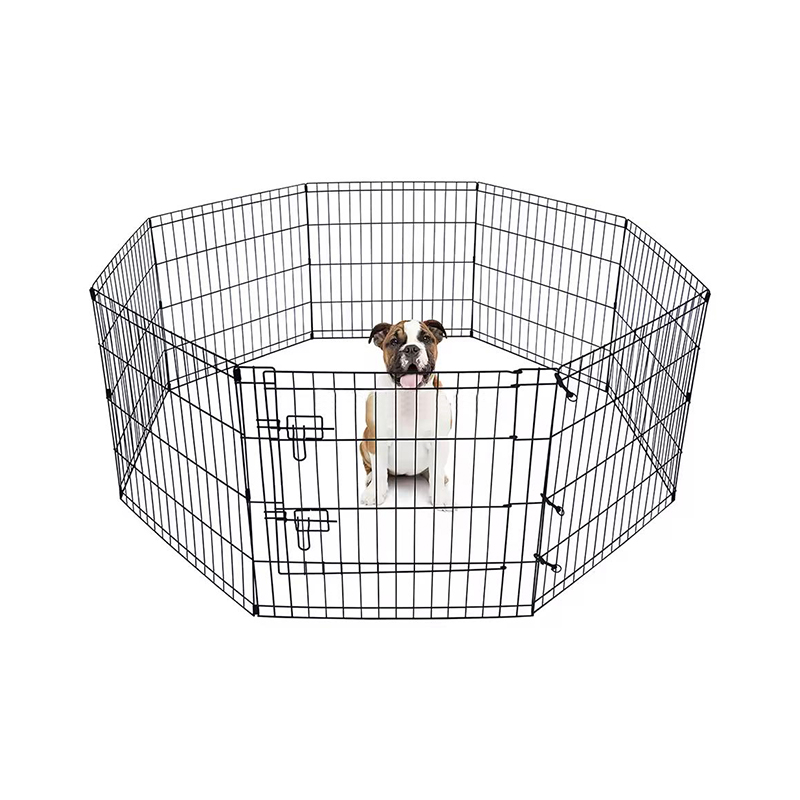
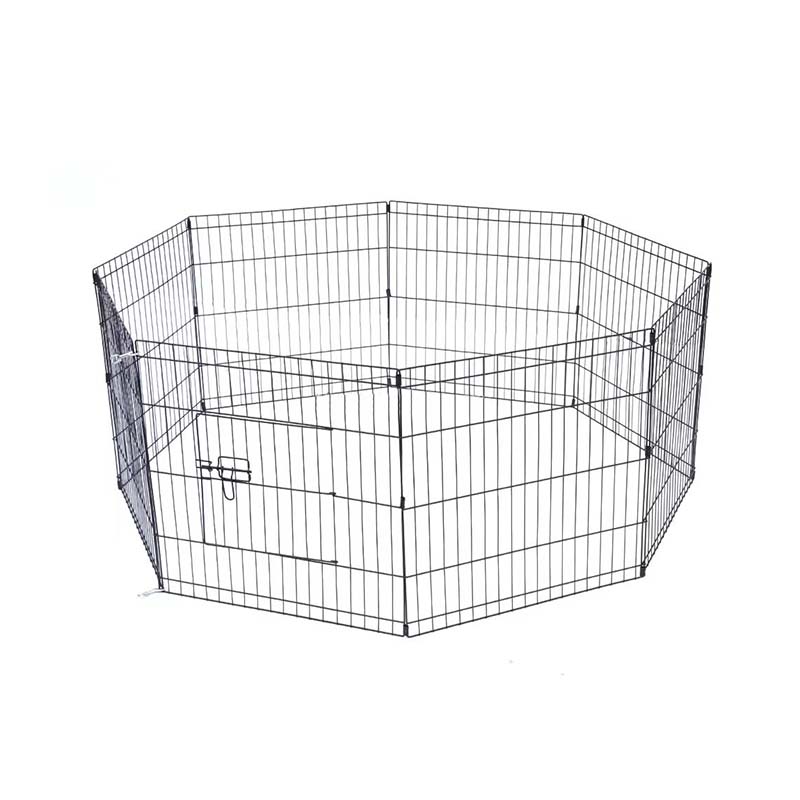
The arithmetic is simple enough to do before ordering. Eight panels of 24 inches form a rough octagon with about 19 square feet of enclosed floor, while four panels of the same width closed into a square give about 4 square feet. If a buyer needs a defined area for a large dog, panel count and panel width decide it; if the pen is meant to attach to a wall, two panels can be left out and the area changes again.
Panel height follows the same logic as crate height but with a different risk. A 24-inch pen restrains a small dog, 32 inches suits most medium dogs, and 40 inches and above is the working range for dogs that jump. Top cover and bottom pad options matter for outdoor use, and they add a small amount to overall height and a measurable amount to packed volume.
Open-air cages for large dogs follow the closed-crate rules with one addition: weather protection. A waterproof cover over a tube frame typically adds 1 to 2 inches to overall height and needs a roof pitch so water does not pool, which means the cover has to be dimensioned slightly larger than the frame rather than exactly matched to it. For yard use, the ground clearance and the base frame matter as much as the interior, because a dog standing in mud will push the whole structure sideways.
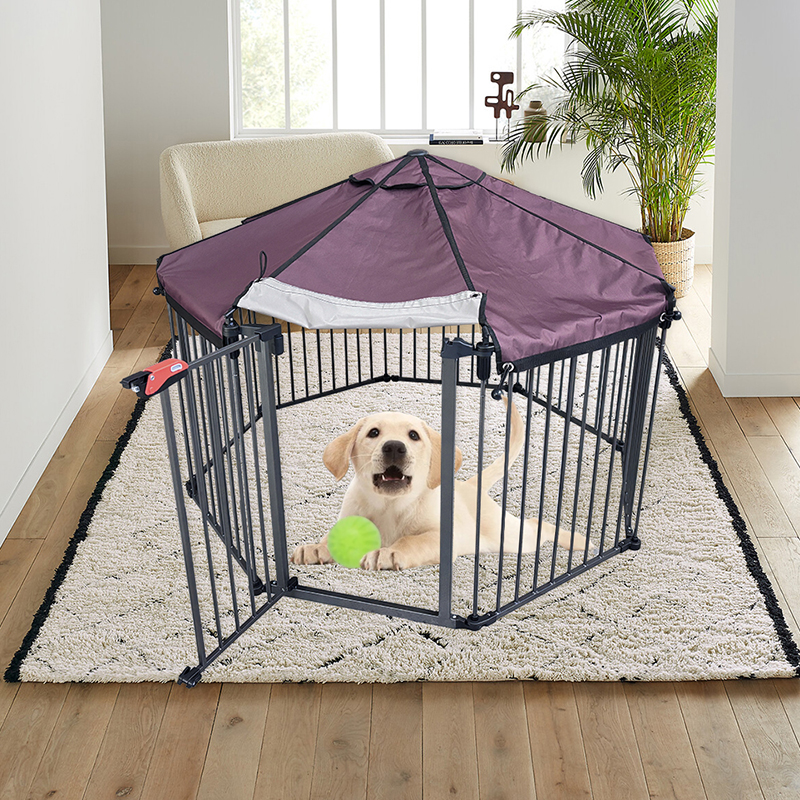 Outdoor Heavy Duty Tube Dog Cage with Waterproof CoverProvides a UV-resistant waterproof top and powder-coated square tube frame for outdoor shelter and roomy movement for larger dogs.View Product →
For playpens and outdoor runs, specify panels, panel width, panel height and enclosed area instead of a single length figure.
Interior Floor Area by Nominal Size: A Visual Comparison
Most sizing arguments disappear once usable floor area is plotted instead of nominal length, because area grows faster than the label number suggests. The chart below uses typical interior figures from the table above and converts them into square inches of usable floor.
Typical usable interior floor area by nominal crate size (square inches)
18 inch
190
24 inch
349
30 inch
504
36 inch
748
42 inch
1040
48 inch
1334
Moving from 36 to 42 inches does not add six inches of floor; it adds roughly 290 square inches, close to 39 percent more usable area, which is why a dog that looks cramped at 36 inches often settles immediately at 42. The jump from 30 to 36 inches is smaller in absolute terms but still meaningful, and the very small classes compress quickly, so a 24-inch crate offers less than half the floor of a 36-inch crate even though the label difference is only 12 inches.
These figures are typical rather than universal, since the door frame, tray position and bar thickness vary between production runs. When our team quotes a private-label programme, we send the interior measurement of the actual sample rather than the class name, so the retail listing and the carton always agree. A buyer comparing several suppliers should do the same: ask for the interior floor area on a production sample, not on a catalogue page. Small differences in frame design accumulate across a full container, and area is the number that customers feel when the product reaches their living room.
Compare crates by interior floor area, because a one-step increase in nominal size often delivers 30 percent or more usable space.
Container, Carton and Wholesale Planning Around Crate Dimensions
For a manufacturer, distributor or wholesaler, the interior dimension is only half the specification. The packed carton decides freight cost, and carton volume is driven by folded thickness rather than by the crate's assembled size. A foldable wire crate that stands 25 inches tall might fold to 2 to 3 inches of thickness, which changes the carton from a bulky box into a flat one.
A workable example: a 42-inch foldable wire crate packed at roughly 44 x 30 x 5 inches occupies about 0.11 cubic metres per unit. Three hundred units land near 33 cubic metres, close to half the usable volume of a 40-foot high-cube container. The same 42-inch crate shipped assembled would consume several times that volume, which is why flat-pack design dominates export programmes. Furniture-style units are different again: knock-down cartons of 0.12 to 0.18 cubic metres per set are common, and hardware bags, cushions and trays add packed volume that has to be counted at the quotation stage.
Stackability adds a vertical dimension to the specification. Two crates stacked need the lower frame to carry the upper load without the latch plates fouling, and the overall stacked height has to stay within retail shelf or pallet limits. Foldable playpens and stackable tube cages are usually designed as a system so that panel heights and latch positions line up; mixing models from different programmes can break that alignment by half an inch and make stacking unsafe.
Tolerances belong in the purchase order as well. State the interior length and width with an acceptable range, name the bar spacing, specify the door opening, and confirm the packed carton dimension on a pre-production sample. A supplier that already runs several production lines and exports to more than twenty countries usually has a standard tolerance it can quote immediately, and that number is far more useful than a promise of exactness.
On the trade side, folded thickness and packed carton volume drive freight cost as much as interior size, so both belong in the same specification sheet.
A Pre-Order Checklist for Owners and Trade Buyers
The checklist below works for a single purchase and for a purchase order of several thousand units. It takes about ten minutes with a tape measure and a sample on the table.
- Measure the dog: nose to tail base, floor to top of head standing, and widest body width.
- Add 2 to 4 inches to length and height, and about 50 percent to width.
- Ask for interior floor dimensions, not the nominal label, and confirm whether the tray sits inside or below the frame.
- Subtract cushion thickness from usable interior height before deciding.
- Check bar spacing against the smallest dog that will use the crate, including a puppy that will grow.
- Measure the door opening and decide whether it swings into the room or against a wall.
- For furniture-style units, record the outer footprint and the tabletop height with wheels fitted.
- For trade orders, confirm folded thickness, carton size, carton weight and container loading plan per model.
- Write the tolerance into the specification so the second shipment matches the first.
Most returns and most buyer disputes trace back to one of these nine points being skipped. None of them require special equipment, and all of them can be answered by a supplier within a day if the questions are asked before the order rather than after the container arrives.
Nine checks, one tape measure: interior figures, clearances, bar spacing, door swing and carton volume cover nearly every sizing risk.
Frequently Asked Questions About Dog Crate Dimensions
What size crate fits a 60 lb dog?
A dog around 60 lb usually falls into the 36-inch class with a comfortable interior of roughly 34 x 21.5 inches, provided the dog is not long-bodied or unusually tall. If the dog stands taller than 23 inches at the head, move to a 42-inch interior instead. Measure the individual dog rather than the weight, because weight says little about back length.
Should I buy a crate one size larger for a puppy?
Buy the adult interior size and use a divider to reduce the usable area to the puppy's current needs. Without a divider, a large crate gives a young dog room to sleep at one end and eliminate at the other, which slows house training. As the dog grows, move the divider back in stages until the full floor is open.
How do I measure my dog for a crate correctly?
With the dog standing on a hard floor, measure nose to tail base for length, floor to the top of the head for height, and across the widest part of the chest for width. Add 2 to 4 inches to length and height, and allow about 50 percent extra width for turning. Always compare the result with interior crate figures, never exterior ones.
Do crate dimensions include the tray and the wheels?
Exterior figures usually include the frame but not always the tray below it or the castors on a furniture-style unit. Castors commonly add 1.5 to 2.5 inches of overall height, and a fixed tray lip can reduce interior width by an inch in total. Ask specifically whether the quoted height is with or without wheels and tray hardware.
What is the real difference between a 42-inch and a 48-inch crate?
In typical interiors, the floor grows from about 1040 to about 1334 square inches, roughly 28 percent more usable area, while interior length grows by around six inches and height by around two. That step matters for giant breeds and for dogs that lie fully stretched out. It matters less for a medium dog that already fits comfortably at 42 inches.
How much space does a dog need to turn around inside a crate?
A practical allowance is roughly half again the dog's body width, which gives enough room to stand, turn and lie flat on one side without pressing against the bars. A dog that can stand but cannot turn will usually sleep leaning on the door, which is an early sign the interior width is too tight.
What bar spacing is safe for a small puppy?
Roughly 1 to 1.5 inches is the safe working range for toy and small breeds, because the risk is a head passing between bars rather than a body escaping. Measure the puppy's head width at the widest point and compare it with the mesh opening before purchase, and recheck the spacing as the dog grows if you plan to reuse the crate for a smaller animal.
Can a manufacturer build a custom interior size?
In most cases yes, within the tooling range of the existing frame and mesh programme. Custom work usually adjusts length and height rather than bar spacing, since spacing is tied to the welded mesh. For a private-label programme, supply the interior figures, the acceptable tolerance, the bar spacing and the packed carton target, and request a production sample before confirming volume.
Do interior dimensions differ between metal and furniture-style crates?
Yes. Wood and wood-metal cabinets usually have thicker side frames, so a 36-inch exterior can leave 33 to 34 inches inside, compared with around 34 inches on a wire crate. Furniture units also carry a cushion that reduces usable height. Compare the two product types by interior floor area and usable height with the cushion in place, not by exterior size.
Almost every question about dog crate dimensions comes back to the same answer: measure the interior, measure the dog, and allow for cushions, wheels and growth.
Where to Go Next
If you are comparing structures before finalising a size, these two pages are worth a look. One explains how an open-top frame changes safety and daily handling, and the other shows how pet furniture pieces are built when the crate has to double as a table.
Related reading and product updates
Both directions lead back to the same starting point. Decide the interior length, width and height first, then choose the structure that delivers those numbers with the bar spacing, door opening and packed volume you can live with.
Fix the interior dimensions before choosing the style, and the crate, the room and the container plan all fall into place.
Related Products
Your pet deserves good, Contact now.
Whether you want to become our partner or need our professional guidance or support in product selections and problem solutions, our experts are always ready to help within 12 hours globally.
 CONTACT US

QUICK LINKS
PRODUCTS
-
Address
- Room 501,Unit 1 ,Buliding 6,Wuyi Guoji Xincheng,No.379,Zhuxi Avenue,Jianyang District,Nanping City, Fujian Province.
- No. 139-6 , Tongyu Middle Road, Nantong, Jiangsu, China
-
Mobile
- +86-13616986006
-
E-mail :

Copyright © 2025 Pet Home (Haian) Co., Ltd All Rights Reserved. Custom Pet Cages Manufacturers OEM/ODM Pet Household Products Factory

