
 EN
 English
 中文简体
Home / News / Industry News / Everything You Need for a Puppy: Crate, Bed and Setup Checklist for New Owners
News


Everything You Need for a Puppy: Crate, Bed and Setup Checklist for New Owners
 2026.11.09
 Industry News
Content
- 1 Everything You Need for a Puppy: The Short List
- 2 Crate Sizing: The Measurement Most New Owners Get Wrong
- 3 What Buyers Check First When Choosing a Puppy Crate
- 4 Playpens and Gates: The Space Between Crate and Free Run
- 5 Sleeping Gear: What a Puppy Needs and What It Will Chew
- 6 Toilet Training: The Setup That Saves the Floor
- 7 The Feeding Station: Bowls, Height and Water
- 8 Collar, Harness, Lead and ID: Fit Rules That Actually Matter
- 9 Grooming and Dental Kit: Buy for the Coat, Not the Breed Name
- 10 Toys and Chews: Sizing Rules That Prevent Expensive Mistakes
- 11 Travel, Vet Registration and the First 48 Hours
- 12 Puppy-Proofing Indoors, Balcony and Garden
- 13 What to Buy Now and What to Wait For
- 14 Buying for a Store, a Brand or a Distribution Business
- 15 Related Reading and Collections
- 16 Frequently Asked Questions
- 16.1 Is it worth buying everything you need for a puppy in one order?
- 16.2 What size crate does a puppy need?
- 16.3 Can a puppy sleep in a playpen instead of a crate?
- 16.4 Do I need a bed if the puppy already has a crate?
- 16.5 How much should the first-month setup cost?
- 16.6 What should a puppy have on the first night?
- 16.7 Which puppy products do wholesale buyers order together most often?
- 16.8 Is a furniture-style cage suitable for a puppy?
The first night a puppy spends in a new home is usually decided before the puppy arrives. Households that already have a correctly sized crate, a washable mat, two bowls that do not slide across the floor and a plan for the 3 a.m. toilet trip settle in within a day. Households that stop at a shop on the way home and buy a bed, a bowl and a bag of food tend to be back at the store before the weekend, replacing half of it. Everything you need for a puppy is not a long list. It is a short list that has to be right the first time.
We have been building pet cages and pet furniture since 2009 and ship to buyers in more than 20 countries, so most of the questions we hear are practical ones. How big should the crate be? Does a playpen replace it? What is worth buying in the first week, and what is money spent too early? This guide answers those questions in the order a new owner actually meets them, from the car journey home to the first month of routines.
Buy containment first, and size it for the adult dog rather than the puppy in front of you. Almost every other item on the list can be bought, swapped or upgraded later without much cost or stress.
Everything You Need for a Puppy: The Short List
Most published checklists run to 25 or 30 items and blend cleaning products, medication and training advice into one block. That is fine for reading but hard to shop from. The list below is grouped by the moment each item starts to matter, and it separates what has to be in the house before the puppy arrives from what can safely wait a week or two.
| Area | What to buy | When |
|---|---|---|
| Containment | Metal crate or furniture-style crate, playpen, stair gate | Before pickup |
| Sleep | Crate mat, cushion or elevated bed | Before pickup |
| Feeding | Two bowls, non-slip mat, the food the breeder was using | Before pickup |
| Toilet setup | Pads, enzyme-based cleaner, poo bags | Before pickup |
| Walking | Collar or harness, lead, ID tag | Before pickup |
| Grooming | Brush matched to coat, nail clipper, puppy shampoo, toothbrush | Week one |
| Enrichment | Three to five chew toys, one puzzle feeder | Week one |
| Travel | Car crate or harness, seat or boot cover | Week one |
| Admin | Vet registration, insurance, microchip paperwork, worming record | Within 48 hours |
Four items do most of the work: containment, sleep, feeding and the toilet setup. Once those are in place, the puppy's day already has a shape, and shape is what makes a new puppy liveable. A crate or pen defines where the puppy rests. A fixed feeding station defines when the day starts. A toilet routine defines where the day's interruptions happen. Everything else is comfort, safety or hobby.
It also helps to know what not to buy. A very young puppy rarely needs a full grooming kit, a raincoat, a second bed or a large toy box. Those become useful at three or four months. In the first fortnight they mostly add clutter to a room the puppy is still learning to read.
If you buy only four things before pickup, buy a correctly sized crate, a washable mat, two bowls and an enzyme cleaner. That combination covers sleep, feeding and the two accidents that will happen on day one.
Crate Sizing: The Measurement Most New Owners Get Wrong
Stand the puppy on a flat floor and measure three things: nose to the base of the tail, the width across the chest, and the height at the shoulder. Add roughly 5 to 10 cm to both the length and the height so the adult dog can stand upright without ducking and turn around without folding. A crate that fits a twelve-week puppy perfectly will be uncomfortable at eight months, which is why most experienced owners buy for the adult size and block off the extra space with a divider while the puppy is small.
Bar spacing matters as much as volume. For toy and small breeds, gaps should be narrow enough that a head cannot pass through but wide enough that a leg cannot slip and jam. Latch security is the second failure point: a puppy that learns to pop a simple slide latch will repeat the trick at 2 a.m., and a door that swings open on a stair landing is a genuine hazard. Look for a latch that needs two motions to open, or a drop-pin design.
Ventilation, floor contact and placement decide whether the crate gets used at all. A crate should sit in a room the household actually occupies, not in a garage or a spare bedroom, because isolation is the fastest way to make confinement feel like punishment. A tray floor makes cleaning practical, and a raised frame keeps the base off a cold floor in winter.
Chew resistance is where cheap crates fail first. Thin wire bends at the weld, powder coating chips at the joints, and once a determined puppy finds a loose end it will work on it every night. Heavier tube frames with wider weld contact and a smooth, thick coating hold up far better through the teething phase, which usually peaks between four and seven months.
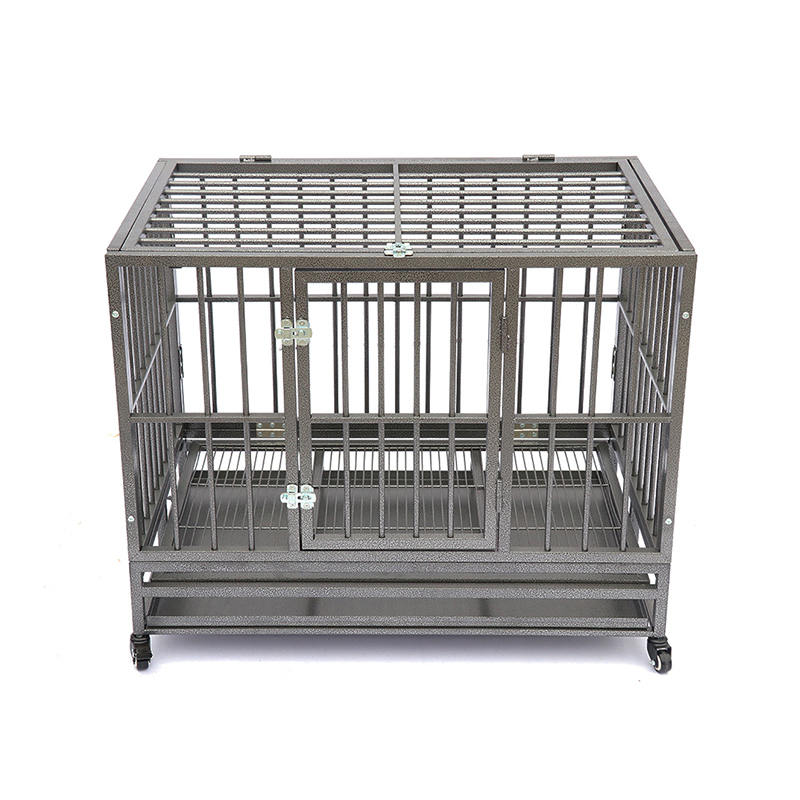
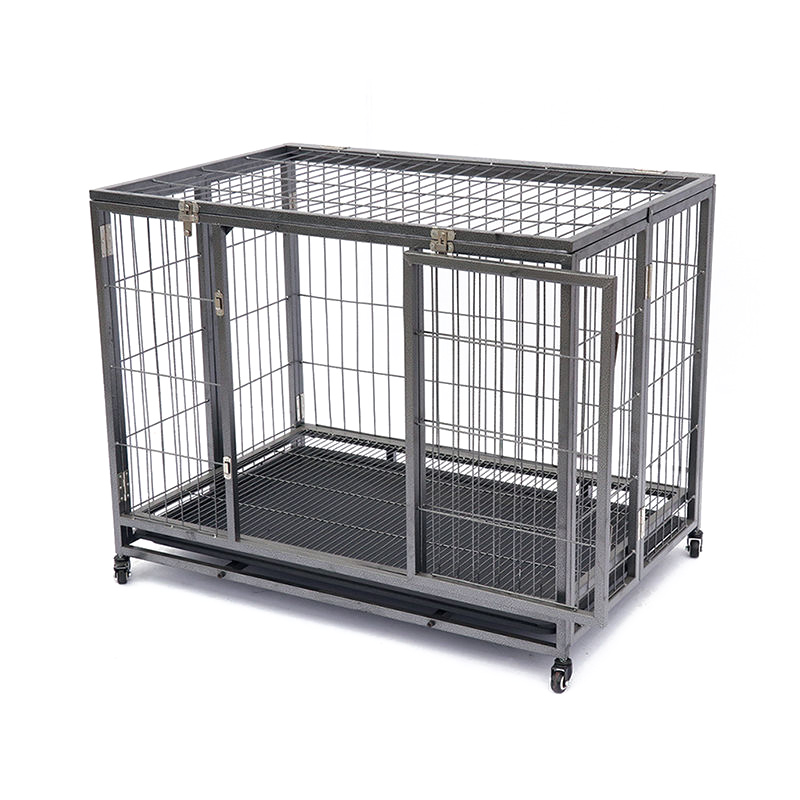
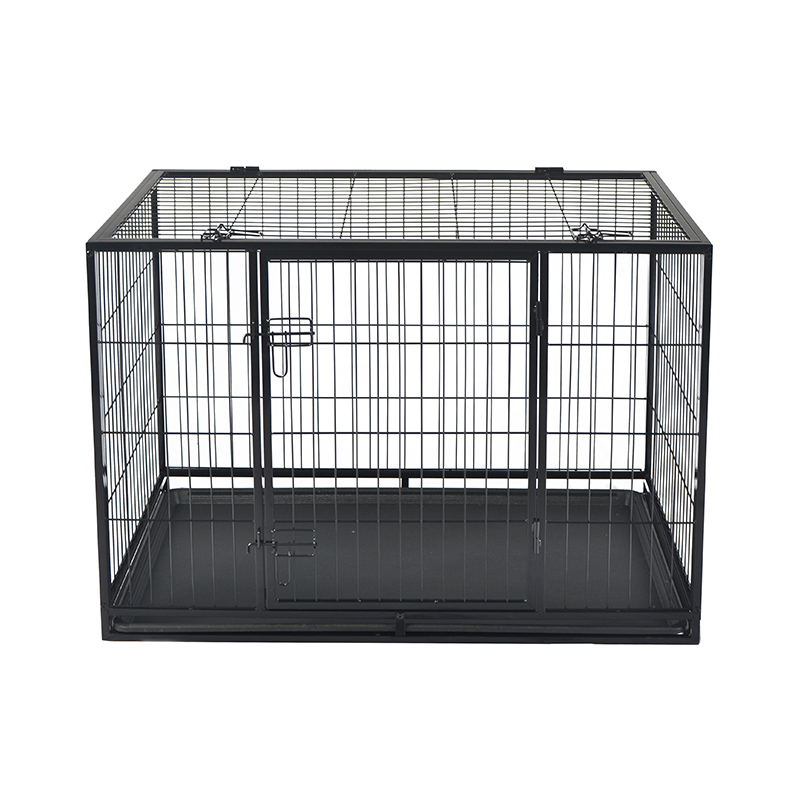
 Heavy Duty Open Top Metal Dog CageOpen-top metal dog crate with front and top access, locking doors, wheels and a pull-out tray for easier lifting, cleaning and steady use.View Product →
An open-top design solves a practical problem that door-only crates create. Lifting a reluctant or sore puppy out through a side door means reaching across the animal, which many puppies read as a grab. A hinged top lets you lift straight up and set the puppy down outside, and it also makes bedding changes and full cleaning much quicker. For households with a puppy that naps deeply and wakes suddenly, the top opening reduces the chance of a startled snap.
Training with the crate is simple and does not need equipment. Feed meals inside with the door open for the first two days, close the door for short stretches while you are still in the room, and build up to ten or fifteen minutes before attempting an hour. Never use the crate as a response to bad behaviour, because it teaches the puppy that confinement follows mistakes. A rough guide to bladder capacity is the puppy's age in months plus one hour, up to a maximum of about four hours during the day.
Measure the adult dog, add the tolerance, then buy once. A crate that is 5 cm too short becomes a crate you replace in four months, and the puppy has to relearn the routine in a new box.
What Buyers Check First When Choosing a Puppy Crate
Price is rarely the first question a buyer asks about a crate; it is usually the last. The order in which people ask about size, door security and cleaning tells you far more about what causes returns and repeat purchases than any price comparison does.
The ranking below is an indicative pattern drawn from enquiry notes across metal and furniture-style crates, not a formal survey. It is useful as a sense of priority rather than a precise measurement.
Crate length against adult dog size
92
Latch and door security
78
Frame and weld strength
71
Tray removal and cleaning
64
Folding and storage
57
Indoor appearance
44
Top opening access
39
Sizing dominates because it is the one error that cannot be fixed later. Door and latch security comes next, and it is the reason heavy-duty tube frames with two-stage latches sell steadily to households with large or anxious puppies. Frame strength and tray access follow closely, which makes sense: these are the two features owners touch every single day.
Indoor appearance scores lower overall but rises sharply in apartments and open-plan homes, where a crate is visible from the sofa. That is exactly the gap furniture-style dog cages were designed to fill, since a wooden end table or corner unit can hold the same metal interior while reading as part of the room. Folding and storage sit in the middle because they matter most to owners who travel or move the crate between rooms.
Top opening access scores lowest of the group, yet it is often the feature that converts a hesitant buyer once they try it. Used together, these priorities explain why our range splits into open-top metal cages for durability and furniture-style cages for living space, rather than one product trying to cover both.
Size is the only crate decision that cannot be corrected with an accessory. Latch quality is second, because a door that opens on its own cancels every other good feature.
Playpens and Gates: The Space Between Crate and Free Run
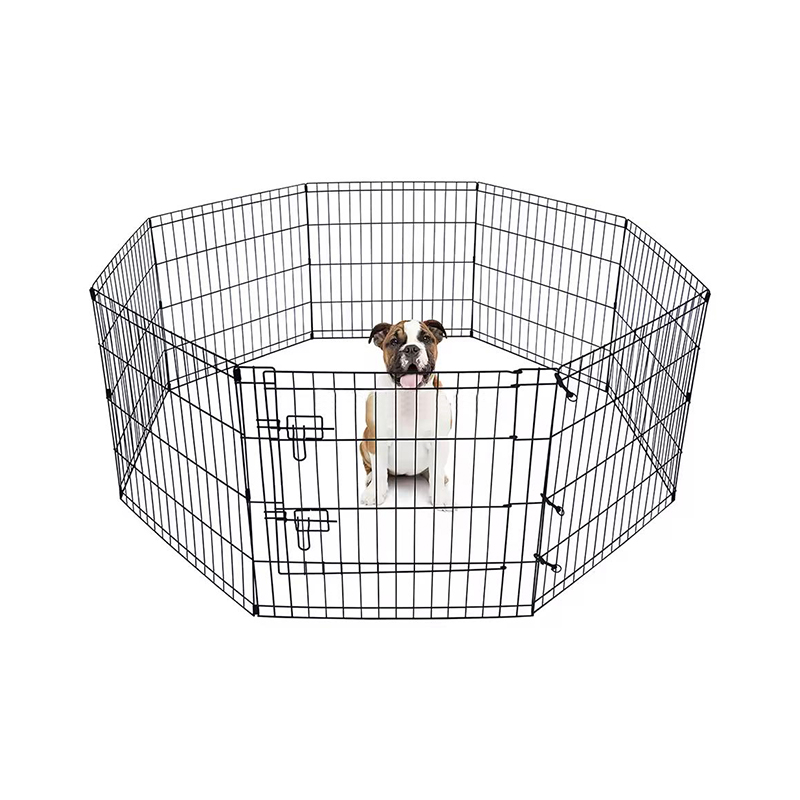
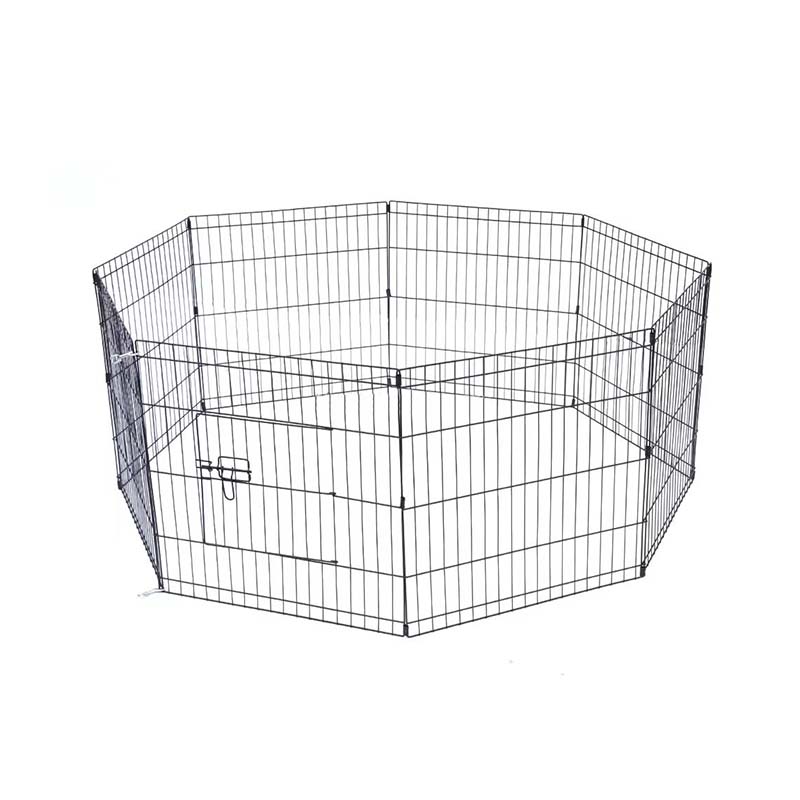
A playpen is not a bigger crate. It is the room you can safely leave for twenty minutes while you answer the door, and that difference changes how you use it. A crate is for sleeping and short confinement; a pen is for awake time, with a bed at one end, water at the other and pads near the edge while toilet habits are still forming. Most eight-panel pens can be clipped directly to a crate door so the puppy can choose between the two.
Panel count and height decide what the pen can hold. Six panels make a compact indoor square; eight panels make a rectangle long enough for a labrador puppy to stretch out. Height matters more than buyers expect, because a determined puppy will test the top rail within the first hour. For breeds that climb, a pen with a top cover converts an escape attempt into a settled nap, and outdoors the same cover doubles as shade and light rain protection.
Material choices follow the same logic as crates. Wire panels are lighter and fold flat for transport; tube frames are heavier and resist bending when a puppy throws its weight against a corner. A bottom pad is worth the small extra cost indoors, because it protects flooring from accidents and stops the pen from walking across a hard floor when the puppy pushes off the sides. Outdoors on grass, ground stakes matter more than anything else in the specification.
One practical warning. A pen is containment, not supervision. Puppies left in a pen in a garden will dig, chew the mesh and test the joins, and the pen should never be the reason a young dog is left outside alone. Used indoors with a proper routine, though, a pen solves the most common complaint we hear from new owners: the puppy is fine in the crate but cannot be trusted loose in the kitchen while dinner is cooked.
Use the crate for sleep and the pen for awake time. Mixing the two jobs in one enclosure is why so many puppies start resisting the crate by week three.
Sleeping Gear: What a Puppy Needs and What It Will Chew
A puppy will sleep between sixteen and twenty hours a day, so the sleeping surface is not a decoration. Two options cover almost every case. A flat cushion or crate mat sits inside the crate and gives the puppy a familiar smell to return to. An elevated bed with a wooden frame lifts the sleeping surface off the floor, which improves airflow underneath, keeps the dog away from cold tiles in winter and makes cleaning underneath straightforward.
Whatever you choose, assume it will be chewed. Puppies explore with their mouths, and the teething phase between four and seven months sends even well-behaved dogs looking for something to destroy. Remove dangling tags, loose stitching and foam that can be pulled out in chunks. Covers that zip off and wash at 30 degrees will be used far more often than covers that need hand washing, and a bed that cannot be cleaned is a bed that ends up in the bin.
 Modern Indoor Wooden Elevated Dog Bed with FrameElevated wooden dog bed frame with anti-slip baffle, rounded edges and non-slip feet; cushion sold separately, stable base for a washable bed.View Product →
Placement follows a simple rule: the puppy should be able to see the household from the bed but not directly in the doorway where people step over it. A corner gives a sense of cover, which most dogs prefer. If the crate is the main sleep spot, keep the second bed in the room where the family sits in the evening so the puppy can be near you without being on the sofa.
Skip the very deep, soft bolster beds in the first month. Small puppies struggle to climb into them, and puppies that cannot get comfortable will choose the floor or, worse, the sofa. A firm, low surface with a washable cover is the safer investment until the adult size is clearer.
Anything that cannot be washed will be thrown away within four months. Buy sleep surfaces for cleanability first and appearance second.
Toilet Training: The Setup That Saves the Floor
Toilet training is a scheduling problem more than a discipline problem. Puppies need to go after waking, after eating, after playing and roughly every hour while very young, and the setup that makes this manageable is simple: a fixed toilet spot, a stock of pads for indoor backup, and an enzyme cleaner that actually breaks down the smell rather than covering it.
Household cleaners are the usual mistake. Ordinary detergent leaves scent markers that tell the puppy this is still a toilet, which is why accidents repeat in the same square metre of hallway. An enzyme-based product digests the residue, and it is worth keeping a second bottle upstairs if the puppy sleeps there. Poo bags belong by the door from day one, not in a drawer, because remembering them is the whole problem.
Crate size and toilet training are directly linked. A puppy will not soil the space it sleeps in if it can avoid it, but a crate that is far too large gives it a corner to use as a toilet. That is the practical reason a divider is not a gimmick: it lets you shrink the space to the puppy's body size and enlarge it as the dog grows.
Clean with an enzyme product, not a fragrant one. The smell you cannot detect is the one the puppy is following back to the same spot.
The Feeding Station: Bowls, Height and Water
Two bowls, one mat, and food identical to what the breeder was feeding. Switching food in the first week is one of the most common causes of loose stools and unnecessary vet visits, so keep the original food for at least a fortnight and transition gradually over five to seven days if you plan to change it.
Stainless steel is the practical choice for most households: it does not hold odour, it survives being dropped and it is easy to sanitise. Ceramic bowls are heavier and stay put, which suits puppies that push their bowl across the kitchen, but they chip on tiled floors and should be checked regularly for cracks. Plastic is the cheapest option and the least durable, since a determined chewer can destroy a plastic bowl in an afternoon.
Bowl height is a topic that attracts strong opinions online. For a puppy, a bowl that sits slightly off the floor is usually enough; very high raised feeders are generally unnecessary until the dog is fully grown, and the decision is best made with your vet if the breed is prone to certain conditions. A non-slip mat underneath solves most of the mess, and it also protects wood flooring from water rings.
Water should be available at all times, refreshed at least twice a day, and offered again after every play session. Puppies forget to drink when they are excited, and a puppy that has been running in a warm garden will empty a bowl quickly. A second bowl in the room where the puppy sleeps saves night-time trips down the stairs.
Keep the food identical for the first two weeks and put a second water bowl where the puppy sleeps. Both changes prevent problems that cost more than the bowls did.
Collar, Harness, Lead and ID: Fit Rules That Actually Matter
A collar should be tight enough that it cannot slip over the head and loose enough for two fingers to slide underneath. Check the fit weekly, because a puppy can outgrow a collar in a month. Flat fabric collars with a quick-release buckle are the safest choice for a young dog that plays rough; metal buckles last longer but are heavier on a small neck.
Harnesses distribute pressure across the chest and are the better option for flat-faced breeds, for puppies that pull hard and for anyone whose dog has a sensitive trachea. A well-fitted harness has two adjustment points and no gaps at the shoulder that a leg can slip through. For the lead, a fixed-length lead of around 1.5 to 2 metres gives enough slack to teach loose-lead walking without encouraging pulling at the maximum extension.
Identification is a legal and practical requirement in most of the markets we supply, though the specific rules differ between countries and even between regions. A lightweight tag on the collar is the visible layer; a microchip registered to your current address is the layer that gets a lost dog home after a gate is left open. Neither replaces the other, and both should be sorted in the first week rather than the first month.
Check the collar every single week until the puppy is full grown. A collar that fitted in March is a collar that slips off in May.
Grooming and Dental Kit: Buy for the Coat, Not the Breed Name
Coat type decides the brush, not the breed label. Short, smooth coats need a rubber curry or a soft bristle brush for a few minutes twice a week. Double coats need an undercoat rake plus a slicker, especially at the seasonal blow-out. Curly and wool coats need a slicker and a metal comb used together, because a slicker alone smooths the surface while leaving mats underneath near the collar and behind the ears.
Nail care is the item most new owners postpone and most dogs later resent. A clipper is quicker for thin nails; a grinder is more forgiving for dark nails where the quick is hard to see. Either way, handle the paws daily for a week before the first trim, and cut only small amounts. Puppy shampoo should be mild and pH-appropriate, and it is worth buying the small bottle rather than the large one, because most puppies are bathed rarely in the first months.
Dental care belongs in the same kit. A soft finger brush and a pet-safe toothpaste introduced as a game in the first fortnight will save years of dental work later. For anyone grooming at home regularly, a grooming table with a strap turns a two-person job into a one-person job and keeps the puppy at a comfortable working height rather than on the floor.
Handle paws, ears and mouth daily for a week before you buy any grooming tool. The handling is what the puppy remembers, not the brush.
Toys and Chews: Sizing Rules That Prevent Expensive Mistakes
The single rule that prevents most toy-related incidents is this: the toy should be larger than the puppy's muzzle when the jaw is closed. A toy small enough to disappear into the mouth is a choking risk, no matter how durable the material claims to be. Squeakers, googly eyes, ribbons and rope tassels all get removed eventually, usually within an hour, so check every toy for loose parts before you hand it over.
Offer a small, rotating selection rather than a full basket. Three or four toys at a time, swapped every few days, keeps interest higher and makes it obvious when something has been destroyed. A chew toy that is harder than a thumbnail can crack a puppy tooth, so choose softer rubber for the teething months and move to firmer options once the adult teeth are through.
Enrichment toys pay for themselves. A puzzle feeder or a stuffed rubber toy in the crate turns a boring twenty minutes into work, and a tired puppy rests far better than a bored one. This is also the cheapest behaviour fix available: most destructive chewing we hear about happens between dinner and bedtime, when the puppy has energy and nothing to do with it.
Rotate three toys rather than offering twelve, and check every one for loose parts weekly. Novelty beats quantity for a puppy every time.
Travel, Vet Registration and the First 48 Hours
How the puppy travels home sets the tone. A hard crate secured in the boot or behind a seat is the safest option, and it becomes the same crate the puppy sleeps in, which builds familiarity quickly. A harness clipped to a seatbelt is a reasonable alternative for short journeys. A loose puppy on a passenger's lap is the one arrangement to avoid, both for safety and because it teaches a habit that is difficult to undo later.
Register with a vet before pickup day where possible. The first appointment usually covers a general health check, weight, a worming schedule and the vaccination plan, and the timing of that plan varies by country and by the vaccines used, so the schedule should come from the clinic rather than from an article. Bring whatever records the breeder supplied, including microchip details and any treatment already given.
Insurance is easier to arrange before any condition exists, since pre-existing issues are usually excluded. The first 48 hours also deserve a written plan: where the puppy sleeps, who takes the night shift, which door leads to the toilet spot, and what happens if the puppy cries for an hour. Deciding those things in advance is the difference between a calm introduction and an exhausting one.
Take the vaccination schedule from your own vet, not from a checklist online. Protocols differ by region and by vaccine type.
Puppy-Proofing Indoors, Balcony and Garden
Puppy-proofing is mostly a low-level view of your own home. Get on the floor and look at what is within reach: cables behind the television, bin bags, shoes, remote controls, laundry pods, houseplants and the cat's food bowl. Cables can be run through rigid conduit or tucked behind furniture. Bins need a lid that latches. Houseplants are worth checking against a toxic-plant list, because a puppy will chew a fallen leaf before it chews a toy.
Stairs and balconies are the two structural risks. A stair gate at the top and bottom prevents both falls and unsupervised climbing, and balcony railings should be checked for gaps a puppy can squeeze through. In the garden, walk the fence line and look for gaps at ground level, loose panels and gates that do not self-close. Puppies dig under fences far more often than they jump over them.
For households that need an outdoor containment area, a heavy-duty tube cage with a waterproof cover handles the job without permanent construction work. The cover matters more than buyers expect: it provides shade in summer, keeps rain off bedding and gives a nervous puppy somewhere to retreat to. Any outdoor enclosure should still be checked for shade, water and ground anchoring before the puppy is left in it, even briefly.
Puppies dig out long before they jump out. Walk the fence line at ground level before you buy another toy.
What to Buy Now and What to Wait For
Timing causes more returns than budget. A harness bought at eight weeks will not fit at sixteen, a bed sized for a puppy is too small by summer, and a grooming kit chosen before the adult coat appears often turns out to be the wrong tool. The schedule below is the one we recommend to new owners who want to buy sensibly without making three trips a week.
| Stage | Add | Skip for now |
|---|---|---|
| Before pickup | Crate, mat, two bowls, collar, lead, pads, enzyme cleaner | Full grooming kit, raincoat, second bed |
| Week one | Brush, nail clipper, three chew toys, puzzle feeder | Grooming table, large toy box |
| Month two | Larger harness, training lead, dental kit, travel crate | Adult-size bed, outdoor kennel |
| Month four | Firmer chews, full-coat grooming tools, upgraded bed | Anything sized for a coat that has not grown in yet |
Two purchases are worth bringing forward if the budget allows: a playpen, because it solves the supervision gap between crate and free run, and a second water bowl, because it costs very little and prevents a surprising number of night-time accidents. Two are worth delaying without exception: the adult-size bed and the full grooming kit.
Buy for the next eight weeks, not the next eight years. Puppies change size faster than any return window.
Buying for a Store, a Brand or a Distribution Business
Retail buyers approach this list from the opposite direction. Instead of asking what one puppy needs, they ask which six SKUs cover the first-year purchase pattern of a typical household and how those SKUs fit into a container. Three product families do the bulk of that work: metal crates in a size ladder, folding playpens, and furniture-style cages that carry a higher price point and a much smaller footprint on the shop floor.
The size ladder is where most range planning starts. A practical line-up runs from small crates for toy breeds through to large and extra-large units for retrievers and livestock-guardian crosses, with each size available in at least one open-top and one folding version. Open-top designs sell well to households with large or nervous puppies because the top door changes how the dog is lifted out. Folding versions suit urban buyers and online sellers who ship flat-packed cartons.
Furniture-style cages are a different purchase. They are bought as furniture first and containment second, so finish, wood grain and colour consistency matter as much as the metal interior. That is why a dedicated furniture-style production line, rather than a converted metal line, produces a more consistent result. Buyers evaluating a supplier should ask for finish samples across production runs, not just one approved prototype.
As a manufacturer working with wholesalers and brand owners, we see the same due-diligence questions on almost every enquiry. What is the carton drop test result? Can the tray be packed separately? Is the coating tested for the destination market's requirements? Can sizes be adjusted for a local market that prefers a 36-inch crate where another prefers 42? A supplier that can answer those in writing, with sample lead times, is a supplier worth a second conversation. Our two metal dog cage lines and one furniture-style line run alongside each other for exactly this reason, and monthly volumes above fifty containers give buyers room to mix cartons rather than committing to a single SKU.
For wholesalers, the useful planning unit is a mixed container rather than a single pallet. Crate sizes, pens, beds and small animal housings travel well together, and a mixed load reduces the risk of a slow-moving size sitting in the warehouse. It also lets a retailer test a furniture-style cage in one finish before committing to a full programme.
Ask any pet cage manufacturer for finish samples from more than one production run. A single approved prototype hides the variation that shows up in a full container.
Related Reading and Collections
Two starting points are worth bookmarking if you want to go deeper than this checklist. The first covers the design reasoning behind open-top cages and how the top door changes handling. The second shows how furniture-style pieces slot into a living room without giving up floor space to a separate crate and side table.
- Why the open-top design on a heavy tube metal dog cage matters for safety
- Pet furniture collection for indoor containment
Read the design notes before you compare prices. Two crates that look identical online often differ in weld contact, latch type and coating thickness.
Frequently Asked Questions
Is it worth buying everything you need for a puppy in one order?
Only if the order is limited to the first eight weeks. Crates, pens, bowls and cleaning supplies can be bought confidently in one go because the puppy's needs there do not change much with age. Harnesses, beds and grooming tools cannot, because the puppy's size and coat will change faster than the products wear out. Splitting the order saves money and reduces returns.
What size crate does a puppy need?
Size the crate for the adult dog. Measure the nose-to-tail length and the shoulder height of the puppy, estimate the adult dimensions for the breed or cross, then add around 5 to 10 cm to the length and height. Use a divider to reduce the interior space while the puppy is small, and remove it as the dog grows. Bar spacing should be narrow enough that a head cannot pass through.
Can a puppy sleep in a playpen instead of a crate?
Some can, but a crate is usually the better sleep environment because the enclosed space is easier to keep warm, easier to cover and more predictable for toilet training. A pen works well as an attached daytime space where the puppy can move between a bed, water and pads. For puppies that climb, a pen with a top cover is the safer configuration.
Do I need a bed if the puppy already has a crate?
You need a surface inside the crate, which can be a simple mat or cushion. A second bed outside the crate is genuinely useful, because it gives the puppy somewhere to settle in the room where the family sits without being on the sofa. Keep the outside bed firm and washable rather than deep and soft.
How much should the first-month setup cost?
The spread is wide, and most of it comes from three decisions: crate material, size of the playpen and whether the crate is furniture-style. Households that buy a basic metal crate, an eight-panel pen and a mat spend far less than those buying a furniture-style unit as the main crate. The cost that surprises people is replacement, not the initial purchase, so correct sizing is the cheapest strategy.
What should a puppy have on the first night?
A crate with bedding, water within reach, a chew toy, the same food as the breeder, and a toilet spot identified before bedtime. Keep the room quiet but not isolated, and expect one or two night-time toilet trips in the first weeks. A light blanket over part of the crate helps some puppies settle.
Which puppy products do wholesale buyers order together most often?
Metal crates in a size ladder, folding playpens and elevated or wooden beds usually travel in the same mixed container, with furniture-style cages added at lower volumes to test a market. Small animal housings and bird cages often fill the remaining space, which keeps freight cost per unit down. A supplier that can mix cartons is more useful than one that insists on single-SKU pallets.
Is a furniture-style cage suitable for a puppy?
It can be, provided the interior dimensions match the adult dog and the doors and latches are secure. The advantage is that the unit does two jobs at once, holding the crate and acting as a side table or corner unit, which matters in smaller homes. The trade-off is that wooden panels need checking for chew damage during the teething months.
Everything you need for a puppy fits into a smaller box than most checklists suggest. Containment sized for the adult dog, a washable sleeping surface, two bowls and a cleaning routine cover the first month. Playpens, grooming tools and travel gear follow as the puppy grows into them, and buying in that order keeps both the budget and the hallway under control.
Get containment, sleep, feeding and cleaning right, and the rest of the puppy list becomes optional upgrades rather than urgent purchases.
Related Products
Your pet deserves good, Contact now.
Whether you want to become our partner or need our professional guidance or support in product selections and problem solutions, our experts are always ready to help within 12 hours globally.
 CONTACT US

QUICK LINKS
PRODUCTS
-
Address
- Room 501,Unit 1 ,Buliding 6,Wuyi Guoji Xincheng,No.379,Zhuxi Avenue,Jianyang District,Nanping City, Fujian Province.
- No. 139-6 , Tongyu Middle Road, Nantong, Jiangsu, China
-
Mobile
- +86-13616986006
-
E-mail :

Copyright © 2025 Pet Home (Haian) Co., Ltd All Rights Reserved. Custom Pet Cages Manufacturers OEM/ODM Pet Household Products Factory

